Why Social Security Disability Review After Age 50 Matters More Than You Think
Social Security Disability Review After Age 50 changes significantly compared to younger beneficiaries. The Social Security Administration (SSA) conducts Continuing Disability Reviews (CDRs) to verify you remain disabled, but your age works in your favor. Here’s what you need to know:
Quick Answer: Key Changes After Age 50
- Review frequency decreases: After age 55, reviews shift to every 5-7 years regardless of your condition
- Easier to keep benefits: Medical-Vocational Grid rules favor older workers who can’t return to past jobs
- Reviews stop completely: At full retirement age (66-67), SSDI converts to retirement benefits—no more reviews
- Lower termination risk: Less than 2% of CDRs result in benefit loss, especially for older recipients
- Age categories matter: The SSA recognizes that workers over 50 face real barriers to learning new work
If you receive Social Security Disability benefits, you may have received a letter notifying you of an upcoming review. This can feel scary—like the SSA is looking for a reason to take away your lifeline. But here’s the truth: the system actually becomes more protective of your benefits as you age.
The SSA understands that a 52-year-old construction worker with chronic back pain faces different realities than a 28-year-old with the same condition. Retraining for desk work isn’t realistic for everyone. The job market discriminates against older workers. These aren’t just opinions—they’re factors built into the SSA’s own regulations.
In 2014 alone, the SSA processed over 900,000 CDRs. Less than 2% resulted in benefit termination. Your chances of keeping benefits improve further after age 50 due to vocational factors that recognize age-related work limitations.
Understanding the Continuing Disability Review (CDR) Process
A Continuing Disability Review (CDR) is essentially a “check-up” by the Social Security Administration. Federal law requires the SSA to reviews your continuing eligibility periodically to ensure that those receiving benefits still meet the medical requirements. We often tell our clients that a continuing-disability-review/ is not an accusation of fraud; it is a routine administrative process.
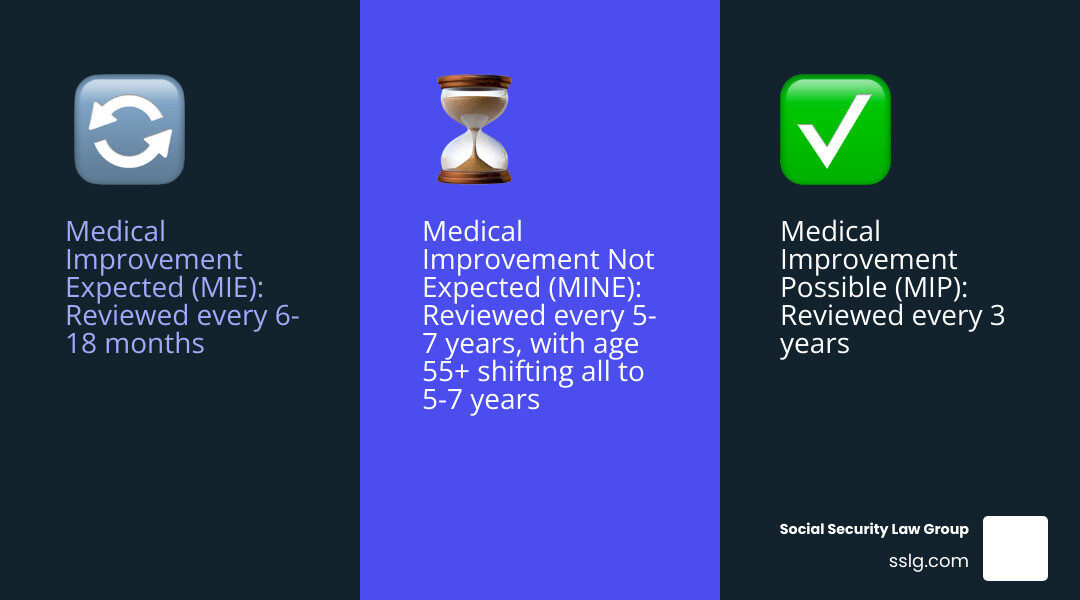
The frequency of these reviews depends on your “diary” classification, which was assigned when you were first approved for benefits. The SSA looks at the likelihood of your medical condition getting better.
| Category | Meaning | Review Frequency |
|---|---|---|
| Medical Improvement Expected (MIE) | Your condition is likely to improve (e.g., recovery from a major surgery or a specific fracture). | Every 6 to 18 months |
| Medical Improvement Possible (MIP) | Your condition might improve, but it’s unpredictable (e.g., some forms of cancer or mental health conditions). | Every 3 years |
| Medical Improvement Not Expected (MINE) | Your condition is considered permanent or stable (e.g., ALS, Parkinson’s, or severe intellectual disability). | Every 5 to 7 years |

For those navigating a Social Security Disability Review After Age 50, you are much more likely to fall into the MIP or MINE categories. The SSA recognizes that as we age, the body’s ability to “bounce back” from severe trauma or degenerative diseases diminishes. If you were originally scheduled for a 3-year review, reaching age 50 often acts as a stabilizer for your benefits.
[trustindex data-widget-id=d5f2eaa65340640cc756060b39a]
How Age Impacts Social Security Disability Review After Age 50
The biggest advantage of being over 50 during a review is the application of the Medical-Vocational Guidelines, commonly known as the “Grid Rules.” These rules are used at Step 5 of the SSA’s evaluation process.
When you are under 50, the SSA generally assumes that if you can do any job—even a simple desk job—you are not disabled. However, social-security-disability-rules-after-age-50/ are much more realistic. The SSA acknowledges that older workers face significant workforce re-entry challenges and ageism in hiring.
The Role of RFC and Transferable Skills
During a review, the SSA determines your Residual Functional Capacity (RFC). This is a fancy way of saying “what you can still do despite your limitations.” They then look at your education and your past work to see if you have “transferable skills.”
Under the grid system, if you are age 50-54 and limited to “sedentary” work, and you do not have skills that easily transfer to a new office job, you can be found still disabled even if you technically could sit at a desk. A 30-year-old in the same position would likely lose their benefits because the SSA assumes they can simply go back to school or learn a new trade. We know that at 52, starting a four-year degree to become an accountant isn’t always a viable path.
The “55 Rule” and Social Security Disability Review After Age 50
Once you hit age 55, you enter the “Advanced Age” category. This is what we like to call the “birthday gift” from the SSA. At this stage, the burden of proof shifts even further in your favor.
Even if your medical condition has shown slight improvement, you may still be found disabled if you are limited to “light work” and have no transferable skills. Furthermore, the continuing-disability-review-after-age-55/ cycle almost always defaults to the 5-7 year MINE schedule. The SSA’s own scientific research on aging and work capacity shows that workers over 55 have an incredibly difficult time adjusting to new work environments, making it less cost-effective for the SSA to constantly review these cases.
Reaching Full Retirement Age and the End of Reviews
One of the most common questions we hear is: “what-age-does-disability-stop/?”
The answer is your Full Retirement Age (FRA), which is currently between 66 and 67 depending on your birth year. When you reach FRA, your SSDI benefits automatically convert into regular Social Security retirement benefits. The amount of money you receive stays exactly the same, but the “disability” label is dropped.
Because you are now receiving retirement benefits, the SSA no longer has the authority to conduct medical reviews. You have reached the finish line! If you are wondering “will-my-disability-benefits-change-when-i-turn-65/,” the answer is generally no—the transition is seamless and marks the end of all CDR stress.
Triggers and Forms: What to Expect in Your Mailbox
A review doesn’t just happen out of the blue; it is triggered by specific events or the calendar. Common triggers include:
- The Calendar: Your 3-year or 7-year diary date arrives.
- Work Activity: You begin earning enough to reach the Substantial Gainful Activity (SGA) threshold. For 2025, this limit is $1,620 per month (or $2,700 if you are blind).
- Self-Reporting: You tell the SSA your condition has improved.
- Third-Party Reports: Someone notifies the SSA that they believe you are working or no longer disabled.
When a review starts, you will receive one of two forms:
- Form SSA-455 (Disability Update Report): This is the “short form.” It’s only two pages long and asks a few basic questions about your recent doctor visits and work status. Most people over 50 with stable conditions receive this form. If you fill it out correctly and there are no “red flags,” your benefits are usually extended without a full medical review.
- Form SSA-454-BK (Continuing Disability Review Report): This is the “long form.” It is 10+ pages and requires a deep dive into your medical history, medications, and daily activities. Receiving this form means the SSA is conducting a full-scale medical review.
If you are working, you may be eligible for a Trial Work Period, which allows you to test your ability to work for nine months without losing your benefits. However, consistently earning above the SGA threshold is the fastest way to trigger a Social Security Disability Review After Age 50.
Protecting Your Benefits: Preparation and Appeals
Preparation is the best defense. We recommend that all our clients maintain a “disability diary” or at the very least, a dedicated folder for medical records. To understand how-to-pass-a-continuing-disability-review/, you must realize that the SSA isn’t looking for a “cure”—they are looking for “medical improvement.”
If your disability-benefits-stopped/ letter arrives, do not panic. You have 60 days to appeal the decision. However, there is a critical 10-day window: if you appeal within 10 days of receiving the notice, you can request that your benefits continue while the appeal is pending. This is vital for maintaining your housing and healthcare.
Navigating a Social Security Disability Review After Age 50 Successfully
To ensure your ssdi-benefits-suspension-termination-2026/ doesn’t happen, follow these three golden rules:
- Treatment Compliance: You must follow your doctor’s prescribed treatment. If the SSA sees that you’ve stopped taking your medication or skipped physical therapy, they may assume you are better—or that you aren’t trying to get better.
- Specialist Documentation: Seeing a general practitioner is good, but seeing a specialist (like a cardiologist or neurologist) is better. Specialists provide the “objective medical findings” the SSA loves.
- Be Honest but Specific: When filling out forms, don’t just say “I have back pain.” Say “I cannot sit for more than 20 minutes without needing to lie down for an hour.” The SSA needs to see how your condition limits your ability to work.
Sometimes the SSA will schedule a “Consultative Examination” (CE) with one of their doctors. This often happens if your own medical records are out of date. While these exams are brief, they are important. We suggest bringing a friend or family member to take notes on what happened during the exam.
Frequently Asked Questions about Disability Reviews
Do Social Security Disability reviews stop at age 55?
No, they do not officially stop, but they become much less frequent. For most beneficiaries, turning 55 means moving to a 5-7 year review cycle. Because you are “approaching retirement age,” the SSA focuses its limited resources on younger beneficiaries who have more years of potential work ahead of them. Unless there is a dramatic medical breakthrough in your condition, a review after 55 is often just a formality.
What are the chances of losing benefits during a CDR after 50?
The chances are statistically very low. As mentioned, less than 2% of all CDRs result in termination. For those over 50, that number is even lower because of the Medical-Vocational Grid rules. To stop your benefits, the SSA must prove “Medical Improvement” related to your ability to work. This is a much higher burden of proof than the initial application process.
How does working part-time affect my Social Security Disability Review After Age 50?
Working part-time is allowed, but it can be a trigger. If you earn more than the SGA limit ($1,620 in 2025), the SSA will likely initiate a review. Even if you earn less than that, the SSA may look at the nature of the work. If you claim you can’t stand but you take a part-time job as a retail greeter, they may question the severity of your limitations. If you’re worried about how long the process takes, you can read more about how-long-does-a-continuing-disability-review-take/.
Conclusion
Navigating a Social Security Disability Review After Age 50 doesn’t have to be a solo journey. At Social Security Law Group, we have been providing expert legal representation for SSDI and SSI claims since 1994. Our unrivaled expertise has led to a 97% success rate, helping thousands of people just like you protect their lifelines.
We operate on a no-win, no-fee structure, meaning you don’t pay us a dime unless we successfully protect or win your benefits. Whether you are in Boston, Dallas, Miami, Orlando, St. Louis, Las Vegas, or any of our other locations across the country, our team is ready to use our modern client technology to make your review process as smooth as possible.
Don’t let a letter from the SSA keep you up at night. We know the rules, we know the “Grids,” and we know how to help you survive your review. Apply for Disability help today and let us take the weight off your shoulders.
Social Security Law Group serves clients in Denver, Boston, Dallas, Ft. Lauderdale, Miami, Orlando, Sarasota, St. Louis, Wichita, Raleigh, Fayetteville, Clark, Uniondale, San Antonio, Jefferson, Southfield, Las Vegas, Jacksonville, Tampa, Bremerton, Fairhaven, and Detroit.