Why Understanding How to Apply for Social Security Disability Matters
How do I apply for social security disability? You can apply three ways: online at the SSA website (ssa.gov/applyfordisability), by calling 1-800-772-1213 (TTY 1-800-325-0778) between 8:00 a.m. and 7:00 p.m. Monday through Friday, or in person at your local Social Security office. The online application is fastest and available 24/7.
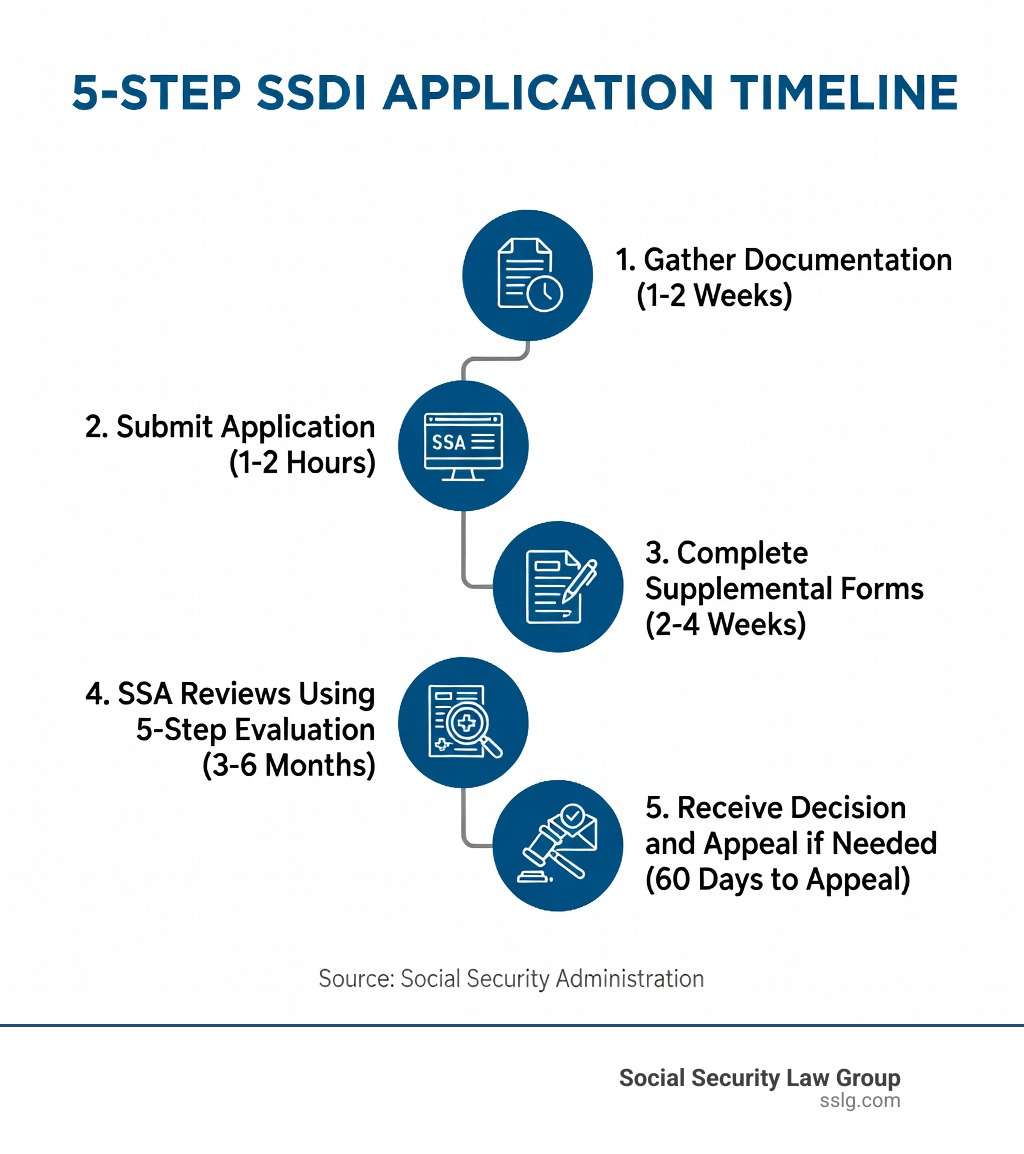
Here’s the complete application process at a glance:
- Gather your documents – Birth certificate, W-2 forms, medical records, work history
- Submit your application – Choose online, phone, or in-person filing
- Complete supplemental forms – Function reports and work history details
- Provide medical evidence – Doctor records, test results, treatment history
- Wait for decision – Average 6-8 months for initial review
If you’re unable to work due to a serious medical condition, you’re not alone. Studies show that a 20-year-old worker has a 1-in-4 chance of developing a disability before reaching full retirement age. Yet the application process feels overwhelming when you’re already struggling with health problems and financial stress.
The reality is tough: only 20% of initial disability applications get approved. But this doesn’t mean you shouldn’t apply. With the right preparation and understanding of what the Social Security Administration (SSA) needs, you can significantly improve your chances.
The average SSDI monthly benefit in 2024 is $1,537, plus Medicare coverage after 24 months. For someone who can’t work, these benefits can mean the difference between financial survival and disaster.
This guide breaks down the entire application process into five manageable steps, showing you exactly what to do, what documents you need, and how to avoid common mistakes that lead to denial.
Understanding SSDI Eligibility and Work Credits
Before we dive into the “how-to,” we need to make sure you’re knocking on the right door. Social Security Disability Insurance (SSDI) is essentially an insurance policy you’ve paid into through your payroll taxes. It’s designed for workers who have reached a point where a medical condition prevents them from working.
To be eligible, you generally need to meet two main requirements:
- You must have a medical condition that meets the SSA’s strict definition of disability.
- You must have worked long enough—and recently enough—in jobs covered by Social Security.
The SSA uses “work credits” to measure this. In 2024, you earn one credit for every $1,730 in wages or self-employment income, up to a maximum of four credits per year. Most people need 40 credits to qualify, with 20 of those earned in the last 10 years leading up to the disability (this is often called the “20/40 rule”). However, if you are a younger worker, the requirements are more lenient. For example, if you become disabled before age 24, you may only need 6 credits earned in the 3-year period ending when your disability starts.

If you aren’t sure where you stand, you can use the SSA’s Benefit Eligibility Screening Tool (BEST) to check your status. It’s also important to note that SSDI is different from Supplemental Security Income (SSI). While SSDI is based on your work history, SSI is a needs-based program for those with limited income and resources.
| Requirement | SSDI | SSI |
|---|---|---|
| Work History | Required (Credits based on age) | Not required |
| Financial Need | Not based on assets | Strict income/asset limits |
| Medical Criteria | Must meet SSA disability definition | Must meet SSA disability definition |
| Health Insurance | Medicare (after 24 months) | Medicaid (usually immediate) |
| Benefit Amount | Based on lifetime earnings | Set federal maximum ($943 in 2024) |
One final piece of the puzzle is your full retirement age (FRA). SSDI is only available to those who haven’t reached their full retirement age. Once you hit that milestone, your disability benefits automatically convert into retirement benefits.
[trustindex data-widget-id=d5f2eaa65340640cc756060b39a]
Qualifying Medically for Benefits
The SSA doesn’t just take your word for it (or even your doctor’s word) that you can’t work. They use a massive manual called the “Blue Book,” officially known as Disability Evaluation Under Social Security. This book lists specific medical criteria for various body systems.
For instance, if you are looking at 14.00 Immune System Disorders – Adult, the SSA lists exactly what clinical signs and lab findings are required to “meet a listing.” If your condition is so severe that it’s on the Compassionate Allowances list—such as certain cancers or adult-onset Huntington’s disease—your application may be fast-tracked for approval.
To qualify, your impairment must be “severe,” meaning it significantly limits your ability to do basic work activities like lifting, standing, walking, or remembering. It must also be expected to last at least 12 months or result in death.
Step 1: Gather Your Documentation and Evidence
Think of your SSDI application like a court case: you need evidence to win. The SSA will eventually request your medical records directly from your doctors, but the more information you provide upfront, the faster the process moves.
A great place to start is the Adult Disability Starter Kit. It includes a checklist and a medical and job worksheet to help you organize your thoughts. We always tell our clients in cities like Chicago and Seattle that organization is the “secret sauce” of a successful claim.
When you are figuring out how-to-fill-out-disability-paperwork, you should gather:
- Names, addresses, and phone numbers of all doctors, caseworkers, and clinics you’ve visited.
- Names and dosages of all medications you take.
- Medical records already in your possession (test results, lab reports, etc.).
- A summary of where you worked and the kind of work you did for the last 15 years.
For a deeper dive into the specific ssa-forms you’ll encounter, check out the official Medical evidence requirements.
Essential Personal and Financial Records
Beyond the medical stuff, the SSA needs to verify who you are and what you’ve earned. You will need:
- Your Social Security number and proof of your age (birth certificate).
- Proof of U.S. citizenship or lawful alien status if you weren’t born in the U.S.
- W-2 forms or self-employment tax returns for the prior year.
- Your Routing Transit Number and account number for direct deposit.
- Proof of any temporary or permanent workers’ compensation-type benefits you received.
- Military discharge papers (Form DD-214) if you served before 1968.
How Do I Apply for Social Security Disability?
Now that you have your mountain of paperwork organized, it’s time to actually file. You might be wondering, “Does it matter where I live?” Whether you are in Houston, Charlotte, or Phoenix, the federal process is the same. However, your local office will handle the non-medical eligibility, while a state agency (Disability Determination Services) handles the medical side.
When asking yourself how do I apply for social security disability, “Substantial Gainful Activity” (SGA) is the big hurdle. In 2024, if you are earning more than $1,550 per month ($2,590 if blind), the SSA generally considers you “working” and will deny your claim regardless of your medical condition. By 2026, these limits are projected to rise to $1,690 ($2,830 if blind).
There are three primary ways to apply-for-disability:
How do I apply for social security disability online?
Applying via the SSA website is the most popular method. It allows you to start the application, save your progress, and come back later. This is particularly helpful if you get fatigued easily.
The social-security-disability-application online covers both the application for benefits and the Adult Disability Report. One major convenience is that the SSA now accepts electronic signatures through services like Adobe Sign or DocuSign, so you don’t have to print and mail as many pages. If you’re wondering can-i-apply-for-ssi-disability-online, the answer is yes, provided you meet certain criteria.
For a step-by-step look at the digital process, visit our guide on applying-for-ssdi-benefits.
How do I apply for social security disability in person or by phone?
If you aren’t comfortable with computers, or if your disability makes using a keyboard difficult, you can call 1-800-772-1213 to schedule an appointment. You can choose to have the interview over the phone or at your local Social Security office.
Whether you are visiting an office in Detroit, Miami, or Denver, the SSA offers a free interpreter service if you prefer to conduct business in a language other than English. For more tips on the interview process, read about how-to-sign-up-for-social-security-disability.
Step 4: Navigating the Five-Step Evaluation Process
Once your application is in, the SSA follows a “sequential evaluation process.” It’s basically a five-question flowchart they use to decide if you are disabled.
- Are you working? If you’re earning over the SGA limit, you’re not disabled.
- Is your condition “severe”? It must interfere with basic work-related activities.
- Is your condition in the “Listings”? If it matches a Blue Book entry, you’re approved.
- Can you do the work you did before? They look at your work-history-report for the last 15 years.
- Can you do any other type of work? They consider your age, education, and transferable skills.
During this time, you will likely be asked to fill out a Function report. This is a critical form where you describe your daily life—how you dress, cook, shop, and socialize. We’ve put together an ssa-function-report guide to help you avoid common traps, like downplaying your pain or exaggerating your abilities. You may also need to submit a Work activity report if you’ve tried to work since your disability began.
Providing Supplemental Information
Sometimes the SSA needs a “second opinion.” They might send you for a “consultative exam” (CE) with a doctor they pay for. This isn’t for treatment; it’s just to get more data.
They might also ask for a Third-party function report, which is filled out by a friend or family member who knows your daily struggles. If your disability was caused by a job injury, you’ll need to complete a Workers’ Compensation/Public Disability Benefit Questionnaire. Always keep the SSA updated with any new medical tests or hospitalizations while your claim is pending. Our social-security-function-report-guide can help you and your family provide the most accurate information.
Step 5: Managing the Decision and Appeals Process
The waiting game is the hardest part. You’ll eventually receive a letter in the mail. If it’s an approval—congratulations! If it’s a denial, don’t panic. Remember: 80% of initial applications are denied.
You have 60 days from the date you receive the denial letter to file an appeal. The stages of appeal are:
- Reconsideration: A complete review of your file by someone who didn’t take part in the first decision. (Approval rate is low, about 10%).
- Hearing: This is your best chance. You’ll speak with an Administrative Law Judge (ALJ). About 50% of cases are approved at this stage.
- Appeals Council: If the judge denies you, you can ask the Council to review the judge’s decision.
- Federal Court: The final step is filing a lawsuit in U.S. District Court.
You will need specific ssdi-forms for each stage. The ssa-appeal-form is your ticket to keeping your claim alive.
The Advantage of Legal Representation
Can you apply for SSDI on your own? Absolutely. Should you? Well, the statistics are eye-opening. According to the Government Accountability Office (GAO), applicants with legal representation are three times more likely to be approved for benefits.
A lawyer helps by:
- Ensuring all ssdi-forms are filled out correctly and consistently.
- Gathering the “right” medical evidence that speaks the SSA’s language.
- Cross-examining vocational experts during hearings.
- Calculating your back pay so you get every cent you’re owed.
If you’re asking, “should-i-get-a-lawyer-before-applying-for-disability,” the answer is often yes, especially since most disability lawyers work on a contingency fee basis. This means they only get paid if you win, and their fee is capped by law (usually 25% of your back pay, up to a certain limit).
Frequently Asked Questions about Applying for Disability
How long does it take to get a decision on my SSDI application?
On average, it takes 6 to 8 months for an initial decision. If you have to go through the entire appeals process to a hearing, it can take 18 months to two years (or more). This is why we recommend learning how-to-apply-for-disability-the-first-time correctly—getting it right the first time can save you years of waiting.
When should I apply for disability benefits?
Apply as soon as you become disabled! There is a mandatory five-month waiting period from your “onset date” before SSDI payments can begin. Since the application takes months to process, waiting to file only delays your first check. Your social-security-benefits-disability-application should be submitted the moment you and your doctors realize you won’t be returning to work for at least a year.
What additional benefits come with SSDI, like Medicare?
One of the biggest perks of SSDI is Medicare eligibility. However, there is a 24-month waiting period for Medicare that starts from your first month of disability entitlement. (Exceptions exist for ALS and End-Stage Renal Disease). Additionally, your spouse or children might be eligible for “family benefits” based on your work record. For more on these perks, see our guide on the disability-benefits-application.
Conclusion
Navigating the Social Security Disability system is a marathon, not a sprint. It requires patience, meticulous record-keeping, and a thick skin for the inevitable paperwork. But you don’t have to walk this path alone.
At Social Security Law Group, we’ve been providing unrivaled expertise in disability law since 1994. Whether you’re in Boston, Dallas, Las Vegas, or Jacksonville, our team is ready to help you secure the benefits you’ve earned. With a 97% success rate and a no-win, no-fee structure, we put our modern client technology and decades of experience to work for you.
Don’t let a denial letter be the end of your story. From San Antonio to Seattle and everywhere in between, we provide local representation with national strength. Apply for disability today and let us help you get your life back on track.