What “Substantial Gainful Activity” Really Means for Your Disability Benefits
What is substantial gainful activity (SGA) is one of the most important questions you can ask before applying for Social Security disability benefits.
Here is the short answer:
Substantial Gainful Activity (SGA) is work that involves significant physical or mental effort and is done for pay or profit. If the Social Security Administration (SSA) decides you can do this kind of work, you will not qualify for disability benefits, regardless of your medical condition.
Two things must both be true for work to count as SGA:
- Substantial – The work requires meaningful physical or mental activity, even if it is part-time or lower-responsibility than past jobs
- Gainful – The work is done for pay or profit, or is the type of work typically done for pay
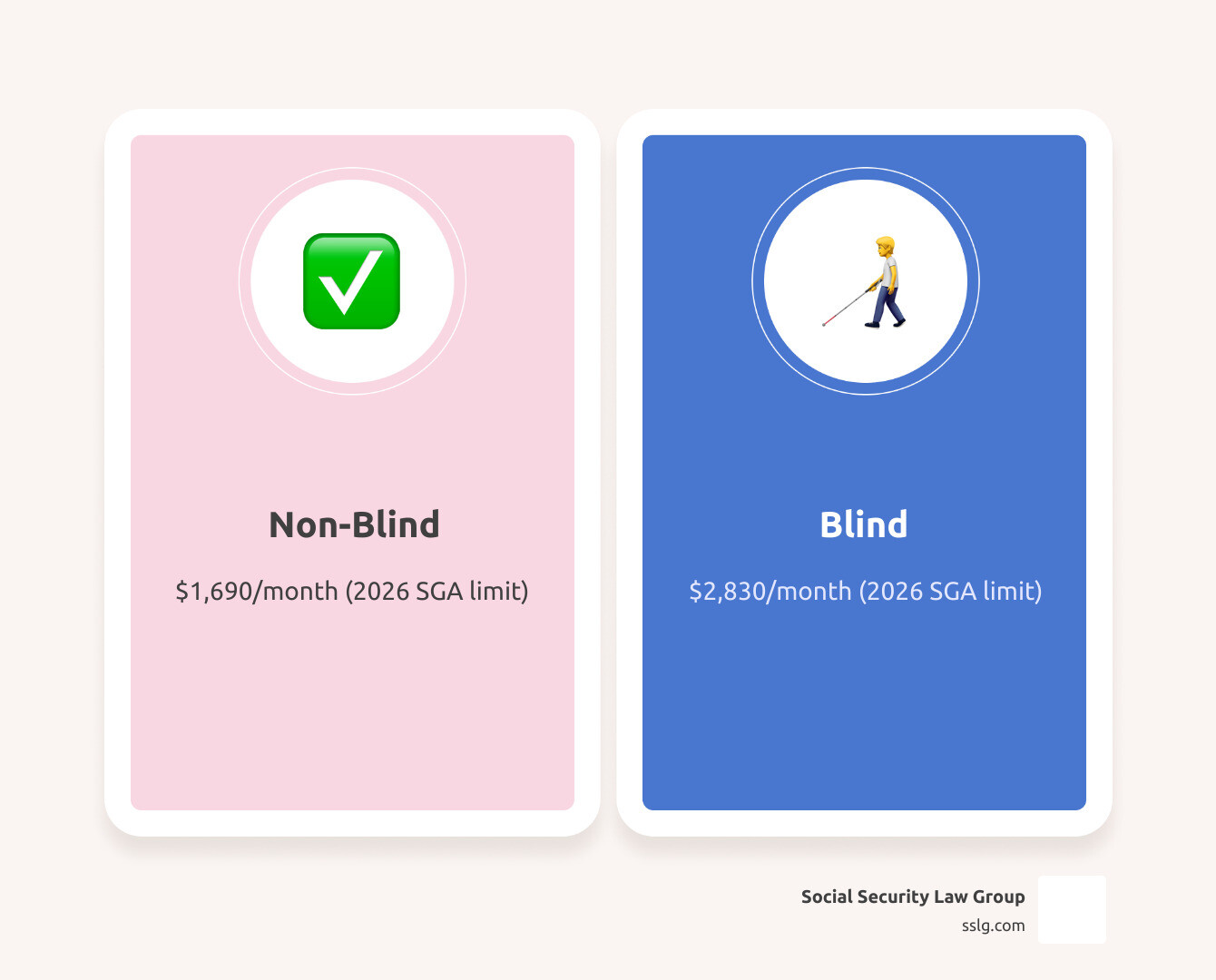
For 2026, the SSA uses these monthly earnings limits to help decide if someone is doing SGA:
| Category | 2024 Limit | 2025 Limit | 2026 Limit |
|---|---|---|---|
| Non-blind individuals | $1,550/month | $1,620/month | $1,690/month |
| Statutorily blind individuals | $2,590/month | $2,700/month | $2,830/month |
Earning above these amounts generally means the SSA will consider you to be engaging in SGA. That can disqualify you from receiving Social Security Disability Insurance (SSDI) or Supplemental Security Income (SSI) benefits.
But the rules go deeper than just a dollar figure. Factors like impairment-related work expenses, employer subsidies, and special work conditions can all affect how the SSA calculates your countable earnings. This guide breaks it all down in plain language.
The information provided in this blog article is intended to be general in nature and should not be construed as legal advice. Social Security laws and regulations are subject to, and often change. Please consult the official Social Security Website or contact SSLG for advice regarding your specific legal matters.
What is Substantial Gainful Activity?

To understand what-is-substantial-gainful-activity, we have to look at how the SSA defines its two core components. Under federal regulation 20 CFR § 404.1572, work is “substantial” if it involves doing significant physical or mental activities. This applies even if you are working on a part-time basis or if you are doing less, being paid less, or have less responsibility than in your previous career.
The “gainful” part refers to work performed for pay or profit. It is important to note that work is considered gainful if it is the kind of work usually performed for pay, even if a profit is not realized in your specific case. For example, if you manage a small business that is currently losing money, the SSA may still view your management duties as gainful activity because those services would typically command a salary in the open market.
The SSA uses this metric as a primary “screen” for disability. If you are currently working and your “countable” earnings exceed the established monthly limit, the SSA will generally find that you are not disabled, regardless of your medical diagnosis. However, certain activities like self-care, household tasks, hobbies, therapy, or attending school are generally not considered SGA.
2026 SGA Monthly Earnings Thresholds
The SSA adjusts the SGA limits annually based on the national average wage index. These adjustments ensure the thresholds keep pace with inflation and wage growth across the United States. Whether you are in Chicago, Houston, or Seattle, these federal limits remain the same.
| Year | Non-Blind Monthly Limit | Statutorily Blind Monthly Limit |
|---|---|---|
| 2024 | $1,550 | $2,590 |
| 2025 | $1,620 | $2,700 |
| 2026 | $1,690 | $2,830 |
These monthly SGA limits act as a “ceiling.” If you earn more than $1,690 per month as a non-blind individual in 2026, the SSA assumes you have the “ability” to engage in substantial work. For those who are statutorily blind, the threshold is higher, reflecting the unique challenges and historical legislative protections afforded to blind workers. It is vital to remember that these figures refer to gross earnings (before taxes) for employees, not take-home pay.
How the SSA Determines if Work is Substantial and Gainful
The SSA does not just look at the total number on your paycheck. They look for “countable income.” To arrive at this number, we look at several deductions and factors that can lower your earnings below the substantial-gainful-activity threshold.
Impairment-Related Work Expenses (IRWE)
If you have to pay for certain items or services to enable you to work because of your impairment, the SSA may deduct these costs from your gross earnings. Examples of IRWEs include:
- Specialized transportation costs (if you cannot use public transit)
- Attendant care services performed in the work setting
- Medical devices, prostheses, or specialized equipment
- Certain medications or medical services required to manage your condition so you can work
Employer Subsidies and Special Conditions
Sometimes an employer provides extra support to a disabled worker that they do not provide to others. This is called a “subsidy.” For instance, if your employer pays you $2,000 a month but provides you with a job coach or allows you to take frequent breaks that reduce your productivity by 25%, the SSA may determine the “real value” of your work is only $1,500. In this scenario, you would be under the 2026 SGA limit.
Evaluating what is substantial gainful activity for Self-Employed Individuals
If you are self-employed, the SSA uses a different set of yardsticks because your monthly income can fluctuate wildly. For the first 24 months of receiving benefits, the SSA typically applies the “Three Tests” to determine if your work is SGA:
- Significant Services and Substantial Income: Are you the sole manager or providing more than half the time needed to manage the business while earning more than the SGA limit?
- Comparability Test: Is your work comparable to that of unimpaired people in your community who are in the same or similar businesses?
- Worth of Work Test: Is your work clearly worth more than the SGA limit to the business, or would it cost that much to hire an employee to do your job?
After you have received SSDI benefits for 24 months, the SSA shifts to the “Countable Income Test,” which focuses more on your actual earnings rather than just the hours or services rendered.
How Part-Time Work Affects what is substantial gainful activity
Many people ask, “will-i-lose-my-disability-if-i-work-part-time?” The answer depends entirely on your earnings and the nature of the work. If your part-time earnings stay below the $1,690 limit (for 2026), you can generally continue to receive benefits.
However, be cautious with volunteer work. While unpaid, if you are performing tasks that are typically paid (like secretarial work or professional consulting) for 30 hours a week, the SSA might argue that you have the “capacity” to earn above the SGA limit, even if you are choosing not to take a paycheck. Even criminal activity, if it involves significant mental or physical effort and produces income, can be evaluated as SGA.
Work Incentives and the Trial Work Period
The SSA actually encourages people to try returning to work through various “Work Incentives.” The most famous of these for SSDI recipients is the Trial Work Period (TWP).
- The Trial Work Period (TWP): This allows you to test your ability to work for at least nine months (not necessarily consecutive) within a 60-month rolling window. During these nine months, you can earn an unlimited amount of money and still receive your full SSDI check. In 2024, any month where you earned over $1,110 triggered a trial work month. You can find more details on our tag/trial-work-period and tag/twp resource pages.
- Extended Period of Eligibility (EPE): Once your 9-month TWP ends, you begin a 36-month “re-entitlement period.” During this time, the SSA will pay you benefits for any month your earnings fall below the SGA limit. If you earn over the limit in a given month, your benefit for that month is suspended, but not terminated.
- Expedited Reinstatement (EXR): If your benefits stop because of your earnings, but you become unable to work again within five years because of the same disability, you can request to have your benefits started again without filing a brand new application.
- Ticket to Work: This program provides free job training and placement services. You can learn more about how this integrates with your claim at Social Security disability ticket to work program.
Frequently Asked Questions about Substantial Gainful Activity
What is an unsuccessful work attempt?
An “unsuccessful work attempt” (UWA) is a period of work that lasts six months or less and ends (or is reduced below the SGA level) because of your impairment or the removal of special conditions that allowed you to work. The SSA does not count UWA earnings when deciding if you are capable of SGA. This policy protects you from losing benefits just because you tried to work but found your disability made it impossible to continue.
Does passive income count as SGA?
Generally, no. Passive income—such as rental income from a property you don’t manage, stock dividends, or interest from a savings account—is not considered SGA for SSDI purposes because it does not require “substantial” physical or mental work. However, for SSI recipients, passive income is considered “unearned income” and will likely reduce your monthly payment amount.
What happens if I exceed the SGA limit?
If you are in your initial application phase and exceed the SGA limit, your claim will likely be denied immediately. If you are already receiving benefits and exceed the limit after your Trial Work Period, your benefits will eventually cease. The SSA usually provides a “grace period” of two additional months of payments after the first month you perform SGA following the TWP. It is your responsibility to report all income changes to the SSA to avoid “overpayments,” which the government will eventually ask you to pay back.
Conclusion
Navigating the rules of what is substantial gainful activity can feel like walking through a legal minefield. Whether you are in Boston, Phoenix, or Atlanta, the stakes are high. One reporting error or a misunderstanding of “countable income” can lead to a benefit termination that takes months or years to fix.
At Social Security Law Group, we have provided expert legal representation for SSD and SSI claims since 1994. With a 97% success rate and a no-win, no-fee structure, we help our clients understand exactly how work affects their eligibility. From our offices in cities like Miami, Detroit, and Charlotte, we use modern client technology to ensure your claim is handled with the precision it deserves.
If you are thinking about returning to work or are worried that your current part-time job might jeopardize your benefits, don’t guess. Contact SSLG for SGA guidance and let our decades of experience work for you.
The information provided in this blog article is intended to be general in nature and should not be construed as legal advice. Social Security laws and regulations are subject to, and often change. Please consult the official Social Security Administration (SSA) website or contact SSLG for advice regarding your specific legal matters.