Who Qualifies for Social Security Survivor Benefits?
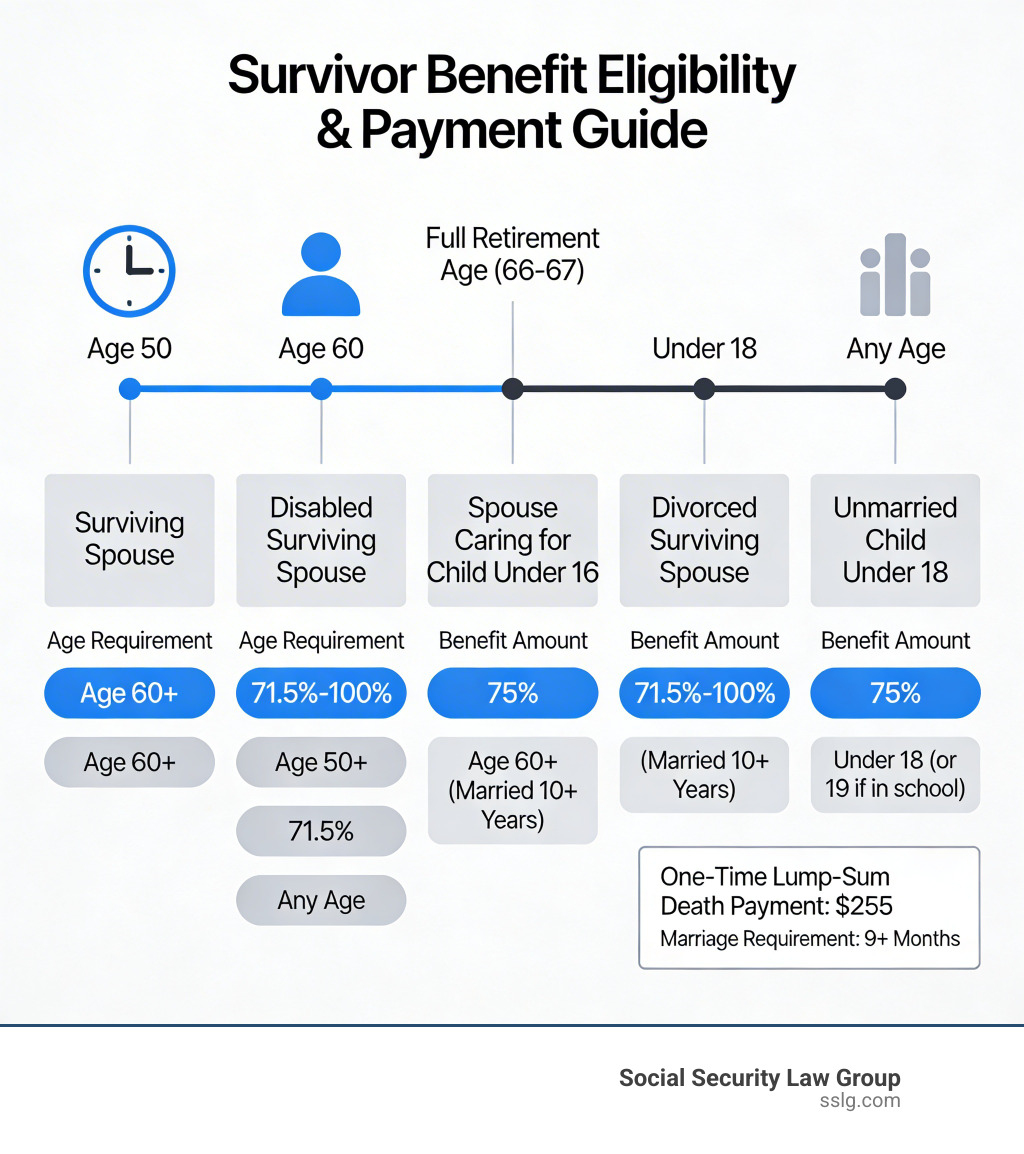
Collecting widows benefits Social Security provides monthly payments to surviving spouses based on their deceased partner’s work record. Here is a quick overview of who can collect and how much they may receive:
Quick Answer: Key Facts About Social Security Widow’s Benefits
| Who | Age Requirement | Benefit Amount |
|---|---|---|
| Surviving spouse | Age 60 or older | 71.5% to 100% of deceased’s benefit |
| Disabled surviving spouse | Age 50 or older | 71.5% of deceased’s benefit |
| Spouse caring for child under 16 | Any age | 75% of deceased’s benefit |
| Divorced surviving spouse | Age 60+ (married 10+ years) | 71.5% to 100% |
| Unmarried child under 18 | Under 18 (or 19 if in school) | 75% of deceased’s benefit |
- Full benefits (100%) are paid at full retirement age (66 to 67, depending on birth year)
- A one-time lump-sum death payment of $255 may also be available
- You must have been married at least 9 months before your spouse’s death
- Benefits apply only to workers who paid Social Security taxes, not SSI recipients
Losing a spouse is one of the hardest things a person can go through. On top of grief, many surviving spouses suddenly face serious financial pressure. If your spouse worked and paid into Social Security, you may be entitled to monthly survivor benefits that can help cover living costs.
But the rules around eligibility, timing, and payment amounts are not simple. The Social Security Administration sets strict criteria, and missing a detail can delay or reduce your benefits. This guide walks you through everything you need to know.
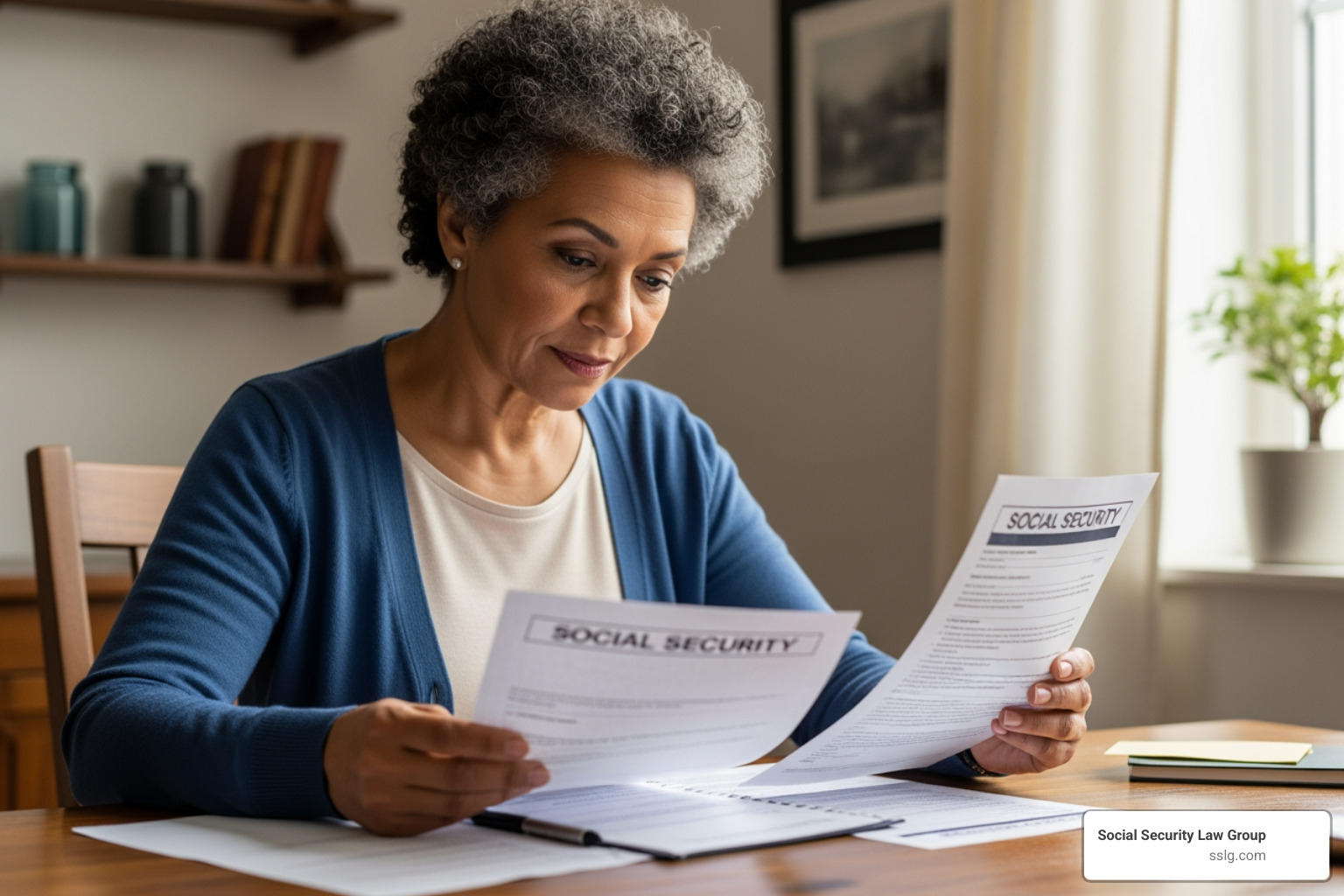
Determining if you are eligible for collecting widows benefits Social Security is the first step toward securing your financial future. At Social Security Law Group, we have seen how these benefits provide a vital safety net for our clients in cities like Boston, Seattle, and Houston. According to the Social Security Administration, survivor benefits are funded by the Social Security taxes paid by the deceased worker during their career.
Generally, a widow or widower must be at least 60 years old to qualify for these benefits. However, if the surviving spouse has a disability, the age requirement drops to 50. In cases where the surviving spouse is caring for the deceased’s child who is under age 16 or disabled, there is no age requirement at all.
Marriage duration is another critical factor. Under Code of Federal Regulations § 404.335, you must typically have been married to the deceased for at least nine months before their death. There are exceptions to this rule, such as if the death was accidental or occurred in the line of military duty. You can Check eligibility for benefits | SSA to see if you meet these fundamental criteria. For more details, you can also view More info about social security disability benefits for spouses.
Eligibility Requirements for Collecting Widows Benefits Social Security
Many people are surprised to learn that a divorced spouse can also be eligible for survivor benefits. If you were married for at least 10 years before the divorce became final, you may qualify for the same benefits as a widow or widower. This is often referred to as the 10 year rule.
One of the best parts of this rule is that the benefits paid to a surviving divorced spouse do not affect the benefit amounts paid to other survivors on the same worker’s record. If you are currently caring for the deceased worker’s child who is under age 16 or disabled, the 10 year marriage rule does not apply. You can use the official tool to Who can get Survivor benefits to verify your specific status. If you have questions about how your marital history impacts your claim, read More info about spousal benefits.
Special Circumstances for Younger Widows and Children
Survivor benefits are not just for spouses. The Social Security system is designed to protect the entire family unit. Unmarried children under the age of 18 (or up to 19 if they are still attending high school full time) can receive benefits. Furthermore, adult children who became disabled before the age of 22 may also be eligible for lifelong support based on their parent’s work history.
Even dependent parents can sometimes qualify. If a worker dies and was providing at least half of the financial support for their parents (who must be age 62 or older), those parents may be eligible for survivor benefits. These rules ensure that the most vulnerable family members are not left without resources. You can explore the full range of Survivor benefits for children online. For those dealing with specific low income scenarios, there is More info about ssi survivor benefits.
Calculating Your Payment: How Much Can You Expect?
The amount you receive when collecting widows benefits Social Security depends heavily on two factors: the deceased spouse’s lifetime earnings and the age at which you begin claiming. If you wait until your full retirement age (FRA), which is 67 for those born in 1960 or later, you are entitled to 100 percent of the deceased worker’s basic benefit amount.
If you choose to claim early, your monthly check will be permanently reduced. For example, a widow claiming at age 60 typically receives about 71.5 percent of the worker’s benefit. This percentage increases every month you wait until you reach your FRA.
| Recipient Relationship | Age at Claim | Percentage of Benefit |
|---|---|---|
| Widow/Widower | Full Retirement Age | 100% |
| Widow/Widower | Age 60 to FRA | 71.5% to 99% |
| Disabled Widow/Widower | Age 50 to 59 | 71.5% |
| Widow/Widower with child under 16 | Any Age | 75% |
| Child of deceased | Under 18/Disabled | 75% |
| One dependent parent | Age 62+ | 82.5% |
You can find a complete breakdown of Survivor benefits payment amounts in official SSA publications. Our team at Social Security Law Group helps clients in cities like Chicago and Atlanta calculate these estimates to make informed decisions. For those whose spouses were receiving disability, see More info about ssdi survivor benefits.
The Family Maximum Benefit Limit
While multiple family members can often claim benefits on one worker’s record, there is a ceiling on the total amount the Social Security Administration will pay out. This is known as the Family Maximum Benefit. According to the SSA’s Office of the Chief Actuary, this limit typically ranges between 150 percent and 180 percent of the deceased worker’s primary insurance amount.
If the total of all individual benefits exceeds this limit, the SSA will reduce each person’s payment proportionately (except for the worker’s own retirement benefit, if applicable) until the total fits under the cap. Interestingly, benefits paid to a surviving divorced spouse do not count toward this maximum limit, which is a significant advantage for families with complex structures.
The One-Time Lump-Sum Death Payment
In addition to monthly checks, there is a small, one-time payment intended to help with immediate final expenses. This is the lump-sum death payment, which is fixed at $255. To receive this, the surviving spouse must have been living in the same household as the deceased at the time of death.
If there is no surviving spouse living in the household, the payment may go to a spouse living elsewhere or an eligible child who is already receiving benefits on the worker’s record. While it is a modest amount, it is an important right to exercise. You can find the Lump-sum death benefit application on the SSA website.
The Process of Collecting Widows Benefits Social Security
Applying for survivor benefits is a process that requires attention to detail. Unlike standard retirement benefits, you generally cannot apply for survivor benefits online. You must either call the Social Security Administration or visit a local office. We often recommend that our clients in Dallas, Phoenix, or Detroit schedule an appointment in advance to avoid long wait times.
The first step is reporting the death. Often, funeral homes will handle this for you if you provide them with the deceased’s Social Security number. However, you should always double check to ensure the report was made. Once the death is reported, you can begin the formal application process. You can find your local SSA Office using the official locator. For a step by step guide on the filing process, see More info about how to apply for survivor social security benefits.
Required Documentation for Your Application
To ensure a smooth application, you should gather your documents early. The SSA requires original documents or copies certified by the issuing agency. According to the Social Security Administration’s application guide, you will likely need:
- Proof of death (usually a death certificate).
- Your own birth certificate.
- Your Social Security number and the deceased worker’s number.
- Your marriage certificate.
- Divorce papers if you are applying as a surviving divorced spouse.
- Dependent children’s Social Security numbers and birth certificates.
- The deceased worker’s W-2 forms or self employment tax returns for the most recent year.
- Your bank account information for direct deposit.
Do not delay your application if you are missing a specific document. The SSA can often help you obtain the necessary records, and filing promptly ensures you do not lose out on benefits.
Common Challenges When Collecting Widows Benefits Social Security
Even with the right documents, challenges can arise. Applications are sometimes denied due to technical errors, such as a failure to meet the marriage duration requirement or issues with the deceased’s work credits. In other cases, the SSA may incorrectly calculate the benefit amount.
If you receive a denial letter, do not panic. You have the right to appeal the decision, but you must do so within 60 days. Our experts at Social Security Law Group have a 97 percent success rate in handling complex Social Security claims and appeals. If your claim was rejected, check out More info about social security survivor benefits denied.
Impact of Remarriage and Work on Your Benefits
Life changes after the loss of a spouse, and those changes can affect your Social Security checks. Two of the most common questions we hear from clients in Charlotte and Las Vegas involve how a new job or a new marriage will impact their eligibility for collecting widows benefits Social Security.
The good news is that Social Security rules are designed to be flexible, but they do have specific thresholds. Understanding these rules before you make a major life decision is essential for protecting your income. You can read more about How work affects your benefits on the official SSA site. For those specifically receiving disability related survivors support, there is More info about social security disability survivor benefits.
Working While Receiving Survivor Benefits
You can work and receive survivor benefits at the same time, but if you are under your full retirement age, your earnings are subject to a limit. For 2026, the annual earnings limit is $24,480. If you earn more than this, the SSA will deduct $1 from your benefits for every $2 you earn above the limit.
In the year you reach your full retirement age, the limit increases significantly, and the deduction drops to $1 for every $3 earned. Once you hit your FRA, there is no limit on how much you can earn, and your benefit amount will stay the same regardless of your income. You can see the latest Earnings limit calculations to plan your work schedule accordingly.
Remarriage Rules for Widows and Widowers
Remarriage is a major milestone that has direct implications for your benefits. If you remarry before you turn 60 (or 50 if you are disabled), you generally cannot continue to receive benefits as a surviving spouse. However, if you remarry after age 60 (or 50 if disabled), your eligibility for survivor benefits on your deceased spouse’s record is not affected.
This rule allows older survivors to find companionship without fear of losing their financial security. If your new spouse is also a Social Security recipient, you may choose to claim a spousal benefit on their record if it is higher than the survivor benefit you were already receiving. You can find more details in the SSA Handbook § 401.
Frequently Asked Questions about Survivor Benefits
Can I switch from widow’s benefits to my own retirement benefits later?
Yes, and this is a powerful strategy for maximizing your income. Many survivors choose to take their widow’s benefits as early as age 60 while allowing their own retirement benefits to grow. By delaying your own retirement claim until age 70, you can earn delayed retirement credits, resulting in a much larger monthly check for the rest of your life.
Once you reach age 70, you can switch from the survivor benefit to your own higher retirement benefit. This flexibility is one of the key advantages of the Social Security system. You can learn more about Choosing between benefits on the SSA’s website.
What happens if I am already receiving Social Security benefits when my spouse dies?
If you are already receiving retirement or disability benefits on your own record, you cannot simply add the survivor benefit on top of what you already get. Instead, the SSA will compare the two amounts. If the survivor benefit is higher, you will receive a combination of benefits that equals the higher survivor amount.
You must report the death to the SSA to have your benefits adjusted. It is important to remember that you cannot keep the Social Security check issued to the deceased spouse for the month of their death or any month thereafter. For instructions on What to report to SSA, visit their survivor portal.
Does the Government Pension Offset affect my widow’s benefits?
If you receive a pension from a government job where you did not pay Social Security taxes (such as some civil service or teaching positions), your survivor benefits may be reduced. This is known as the Government Pension Offset (GPO).
Under the GPO, your survivor benefit is typically reduced by two thirds of the amount of your government pension. In some cases, this can reduce the survivor benefit to zero. It is a complex rule that requires careful planning. You can find Government Pension Offset (GPO) details on the official SSA website to see how it might apply to your situation.
Conclusion
Navigating the rules for collecting widows benefits Social Security can feel overwhelming, especially during a time of personal loss. Whether you are in Denver, Miami, or Seattle, the Social Security Law Group is here to provide the expert legal representation you need. Since 1994, we have dedicated our practice to helping individuals secure the disability and survivor benefits they deserve.
With a 97 percent success rate and a no-win, no-fee structure, we ensure that every client has access to top tier advocacy without up front costs. We use modern technology to keep you informed every step of the way, providing peace of mind during a difficult transition. If you are ready to explore your options or need help with a denied claim, contact us today. For more information on how we can help, see More info about ssdi survivor benefits.