What SSDI SGA 2025 and 2026 Mean for Your Disability Benefits
SSDI SGA 2025 and 2026 refer to the Substantial Gainful Activity earnings limits that the Social Security Administration (SSA) uses to determine whether a disability benefits recipient is working at a level that can affect eligibility. The key numbers are published by the SSA here: https://www.ssa.gov/oact/cola/sga.html.
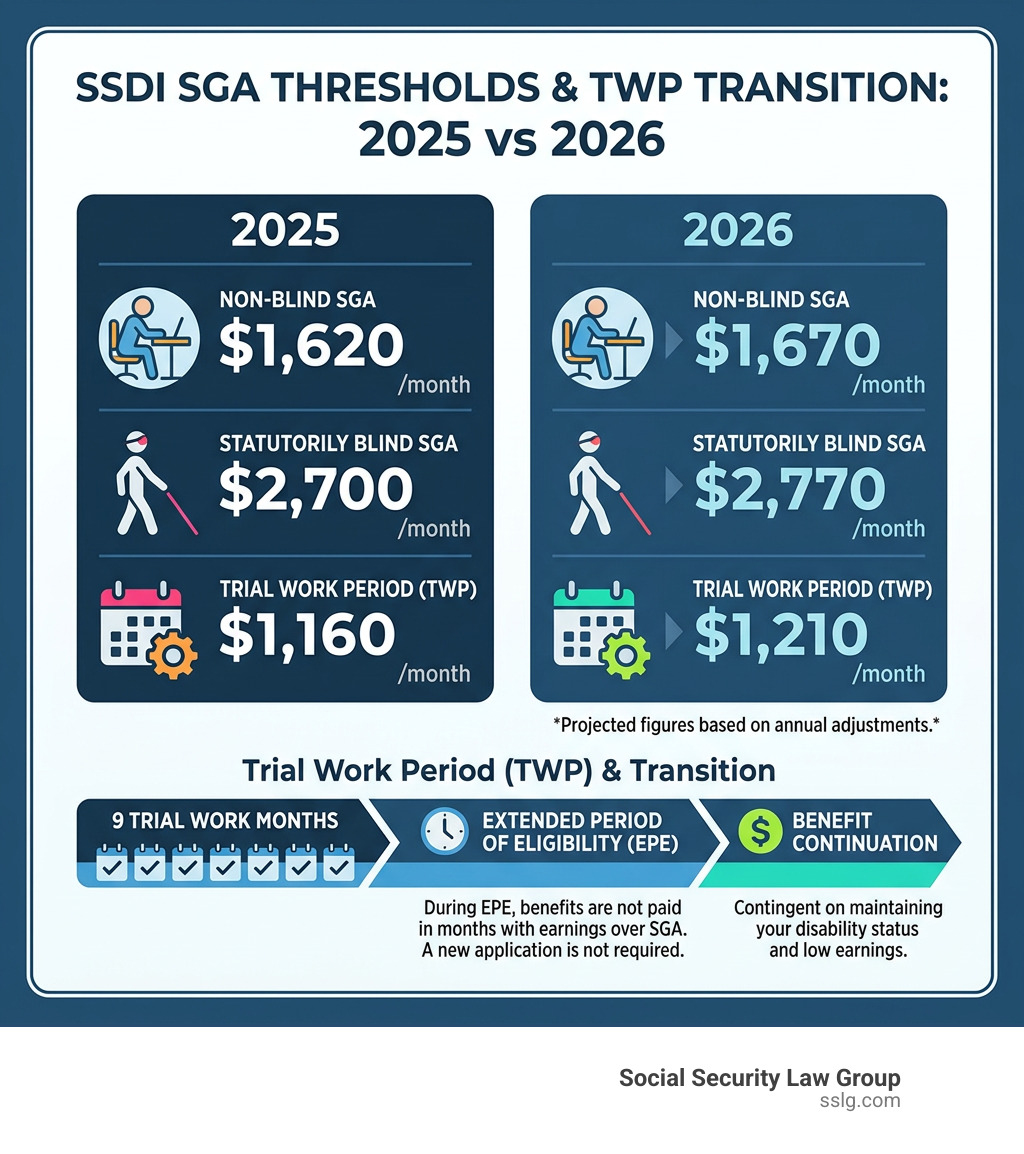
| Category | 2025 Monthly Limit | 2026 Monthly Limit |
|---|---|---|
| Non-blind disabled workers | $1,620 | $1,680 |
| Statutorily blind workers | $2,700 | $2,790 |
| Trial Work Period (TWP) threshold | $1,160 | $1,180 |
Source: Determinations of Substantial Gainful Activity (SGA) and Trial Work Period (TWP) threshold for 2025
If your monthly earnings stay below these limits, your SSDI benefits are generally not at risk, subject to SSA work incentive rules and reporting requirements (SSA: https://www.ssa.gov/benefits/disability/work.html).
As of January 2025, the SSA reports it was paying disability benefits to millions of beneficiaries, and it publishes the average monthly disabled worker benefit in its annual Fast Facts publication (SSA: https://www.ssa.gov/policy/docs/chartbooks/fastfacts/2025/fastfacts25.html). Because many recipients have earnings near the SGA limit, understanding SGA is critical for beneficiaries in Denver, Chicago, Seattle, Boston, Houston, Phoenix, Miami, Atlanta, Charlotte, Detroit, Las Vegas, and Raleigh (SSA work rules: https://www.ssa.gov/benefits/disability/work.html).
These limits adjust annually based on national wage growth, and the SSA publishes both current and prior year SGA amounts (SSA: https://www.ssa.gov/oact/cola/sga.html). The 2026 SGA and TWP amounts are also published by SSA on its annual COLA and work incentive pages (SSA SGA: https://www.ssa.gov/oact/cola/sga.html; SSA TWP: https://www.ssa.gov/oact/cola/twp.html).
This guide explains how SGA is evaluated, what can count, and how to protect your benefits if you want to work (SSA Red Book: https://www.ssa.gov/pubs/EN-64-030.pdf).
Terms related to ssdi sga 2025:
Understanding Substantial Gainful Activity (SGA)
The most important concept to understand is Substantial Gainful Activity (SGA), which the SSA uses to decide if your work activity is significant enough to affect disability eligibility (SSA: https://www.ssa.gov/benefits/disability/work.html). To be considered “substantial,” the SSA explains the work generally involves significant physical or mental activities, and this can include part-time work depending on the duties performed (SSA: https://www.ssa.gov/oact/cola/sga.html).
The “gainful” part generally refers to work performed for pay or profit, and the SSA explains that work activity may be considered even if it is not profitable in some circumstances (SSA: https://www.ssa.gov/benefits/disability/work.html). If you are in Denver, Chicago, or Seattle, the SSA applies the same federal SGA framework nationwide (SSA: https://www.ssa.gov/oact/cola/sga.html).
If the SSA determines you are performing SGA, it can be evidence you are able to engage in competitive work, which can affect disability entitlement under SSA rules (SSA: https://www.ssa.gov/benefits/disability/work.html).

The SSDI SGA 2025 and 2026 Earnings Thresholds
The SSA adjusts SGA limits annually and publishes them in its COLA SGA tables (SSA: https://www.ssa.gov/oact/cola/sga.html). For ssdi sga 2025, the thresholds increased from 2024, and the SSA also publishes the 2026 amounts (SSA: https://www.ssa.gov/oact/cola/sga.html).
| Year | Non-Blind SGA Limit | Statutorily Blind SGA Limit |
|---|---|---|
| 2024 | $1,550 | $2,590 |
| 2025 | $1,620 | $2,700 |
| 2026 | $1,680 | $2,790 |
The SSA also publishes the technical determination tables for SGA, including the prior-year base amounts and computation methodology (SSA: https://www.ssa.gov/oact/COLA/sgadet.html). If you are statutorily blind, the SSA provides a higher SGA dollar threshold as reflected in the published SGA amounts (SSA: https://www.ssa.gov/oact/cola/sga.html).
Navigating the Trial Work Period and Extended Period of Eligibility
If you want to test your ability to return to the workforce, the SSA provides the Trial Work Period (TWP), which allows you to work and still receive your full SSDI benefits for months that count as trial work months, subject to SSA rules (SSA: https://www.ssa.gov/benefits/disability/work.html). The SSA publishes the monthly earnings amount that generally triggers a TWP month each year (SSA: https://www.ssa.gov/oact/cola/twp.html). The TWP threshold for 2025 is $1,160 per month, and for 2026, it is $1,180 per month (SSA: https://www.ssa.gov/oact/cola/twp.html).
The SSA explains that you generally receive up to nine trial work months within a rolling 60-month period, and the months do not have to be consecutive (SSA: https://www.ssa.gov/benefits/disability/work.html). Once the Trial Work Period ends, the SSA explains that beneficiaries enter the Extended Period of Eligibility (EPE), which lasts 36 months (SSA: https://www.ssa.gov/benefits/disability/work.html).
During the EPE, the SSA evaluates work and earnings month to month using the applicable SGA amount for the year, and it can reinstate payments for months earnings fall below SGA without a new application during that EPE window (SSA: https://www.ssa.gov/benefits/disability/work.html). This month-to-month structure can be especially important for beneficiaries in Boston, Houston, and Phoenix who have fluctuating conditions and fluctuating work capacity (SSA: https://www.ssa.gov/benefits/disability/work.html). More info about SSDI eligibility can help you track where you stand in these timelines.
Calculating Countable Income and Deductions for ssdi sga 2025
The SSA evaluates whether you are engaging in SGA using countable earnings, and the agency recognizes that certain disability-related costs and supports can reduce the amount of earnings it counts under its work incentives (SSA Red Book: https://www.ssa.gov/pubs/EN-64-030.pdf; SSA work rules: https://www.ssa.gov/benefits/disability/work.html). This is important for beneficiaries working in Charlotte, Detroit, and other local markets where job duties and accommodations can vary, but federal rules apply consistently nationwide (SSA: https://www.ssa.gov/benefits/disability/work.html).
One common category is Impairment-Related Work Expenses (IRWE), which the SSA describes as certain costs for items or services you need in order to work because of your disability (SSA Red Book: https://www.ssa.gov/pubs/EN-64-030.pdf). Examples can include:
- Specialized transportation or modifications to a vehicle (SSA Red Book: https://www.ssa.gov/pubs/EN-64-030.pdf).
- Attendant care services performed in the work setting (SSA Red Book: https://www.ssa.gov/pubs/EN-64-030.pdf).
- Medical devices, such as wheelchairs or respirators (SSA Red Book: https://www.ssa.gov/pubs/EN-64-030.pdf).
- Certain prosthetic devices or specialized work equipment (SSA Red Book: https://www.ssa.gov/pubs/EN-64-030.pdf).
The SSA also discusses subsidies and special conditions, which may apply when an employer pays a full wage but the actual value of the work is reduced due to disability-related supports or accommodations (SSA Red Book: https://www.ssa.gov/pubs/EN-64-030.pdf). More info about understanding substantial gainful activity explains how these adjustments are calculated.
Reporting Earnings to Avoid ssdi sga 2025 Overpayments
The SSA requires beneficiaries to report changes in work activity and earnings, and the agency explains that prompt reporting helps prevent overpayments (SSA: https://www.ssa.gov/benefits/disability/work.html).
The SSA also describes services that can help verify wages, including electronic wage reporting approaches and employer wage data matching initiatives used by the agency to improve payment accuracy (SSA: https://www.ssa.gov/benefits/disability/work.html). More info about will I lose my disability if I work part-time highlights the importance of keeping the SSA informed.
Special Rules and ssdi sga 2025 Exceptions
The SSA applies different SGA evaluation rules for self-employment and may consider net earnings and the value of services performed, not just profit (SSA: https://www.ssa.gov/benefits/disability/work.html). Passive income such as interest, dividends, or rental income generally is not treated as earnings from work activity for SGA purposes, although the SSA can consider whether activities reflect work capacity depending on the facts (SSA: https://www.ssa.gov/benefits/disability/work.html). More info about social security disability requirements can clarify how the SSA views non-traditional income streams.
Maintaining Benefits and Medicare Coverage While Working
Many SSDI recipients are concerned about keeping health coverage if cash benefits stop due to work. The SSA explains that Medicare can continue for at least 93 months after the Trial Work Period ends if you continue to have a disabling impairment, even if benefits stop because you are working (SSA: https://www.ssa.gov/benefits/disability/work.html).
You may still be responsible for Medicare Part B premiums, and official premium and cost information is published by Medicare (official U.S. government site: https://www.medicare.gov/basics/costs/medicare-costs). This extended coverage can be especially important for beneficiaries in Miami and Atlanta where maintaining continuous access to care is a priority (SSA: https://www.ssa.gov/benefits/disability/work.html).
Frequently Asked Questions About SSDI SGA 2025
What happens if I exceed the SGA limit?
If you exceed the applicable SGA limit after your Trial Work Period has ended, the SSA generally determines that disability benefits may stop due to work activity, subject to the rules of the Extended Period of Eligibility and other work incentives (SSA: https://www.ssa.gov/benefits/disability/work.html). The SSA explains that it applies a grace period in certain situations when benefits stop due to work at the SGA level (SSA: https://www.ssa.gov/benefits/disability/work.html).
How does the SSA calculate SGA for self-employed individuals?
The SSA explains that self-employment is evaluated under specific tests that can consider the value of services to the business, comparability of work, and net earnings (SSA: https://www.ssa.gov/benefits/disability/work.html).
Are there special SGA rules for younger workers or children?
The SSA explains that non-medical rules such as insured status and work credits can differ by age, and it publishes how work credits are earned and how many credits are needed depending on age (SSA: https://www.ssa.gov/benefits/retirement/planner/credits.html). For Disabled Adult Child benefits, eligibility rules are also described by SSA, including how disability and benefits can be affected by work (SSA: https://www.ssa.gov/benefits/disability/qualify.html; SSA work rules: https://www.ssa.gov/benefits/disability/work.html).
Conclusion
Working while receiving disability benefits can be complex, but the SSA provides work incentives, including the Trial Work Period, Extended Period of Eligibility, and continued Medicare coverage for qualifying beneficiaries (SSA: https://www.ssa.gov/benefits/disability/work.html). Understanding how SGA applies in 2025 and the updated 2026 amounts can help beneficiaries in Las Vegas, Raleigh, Denver, Chicago, Seattle, Boston, Houston, Phoenix, Miami, Atlanta, Charlotte, and Detroit plan employment decisions in a way that reduces the risk of overpayments and unexpected benefit suspensions (SSA SGA: https://www.ssa.gov/oact/cola/sga.html).
If you have questions about how your 2025 or 2026 earnings will affect your status, more info about substantial gainful activity services is available.
The information provided in this blog article is intended to be general in nature and should not be construed as legal advice. Social Security laws and regulations are subject to, and often change. Please consult the official Social Security Administration (SSA) website or contact SSLG for advice regarding your specific legal matters.