Understanding Vocational Expert Testimony in Social Security Disability Cases
Vocational expert testimony is a critical component of Social Security disability hearings that can determine whether you receive benefits or face denial. A vocational expert (VE) is an impartial professional who testifies about jobs in the national economy and whether you can perform work given your limitations.
Quick Answer: What You Need to Know About Vocational Expert Testimony
- Who they are: Neutral professionals qualified to assess job markets and vocational factors
- What they do: Classify your past work and identify jobs you might perform despite limitations
- When they testify: Typically at disability hearings before an Administrative Law Judge (ALJ)
- How they impact your case: Their testimony helps the ALJ decide if you can work at Step 5 of the sequential evaluation
- What you can do: You have the right to question the VE and challenge their testimony through an experienced disability attorney
If you’ve received a denial and are preparing for a hearing in California or Las Vegas, understanding how vocational experts work is essential. Many claimants feel blindsided when a VE testifies they can perform jobs they’ve never heard of—jobs that may no longer exist or have been performed differently for decades.
The reality is this: VE testimony doesn’t automatically mean denial. According to Social Security Administration data, judges approved just over 50% of cases after hearings in 2022. The VE is just one piece of evidence. Your medical records, your own testimony, and how well your attorney cross-examines the VE all matter significantly.
This guide will walk you through everything you need to know about vocational expert testimony—from how VEs classify your work history using the Dictionary of Occupational Titles to the “killer limitations” that can eliminate every job they identify. You’ll learn what questions ALJs ask VEs, how to spot problems with their testimony, and what your attorney should do to challenge unreliable vocational evidence.
What is a Vocational Expert and Why Do They Testify?
A Vocational Expert (VE) is a professional who provides impartial expert testimony during the Social Security disability hearing process. While they are paid by the Social Security Administration (SSA) for their time, they are not employees of the SSA. Their role is to act as a neutral consultant to the Administrative Law Judge (ALJ).
Under 20 CFR 404.1566, the SSA has the authority to use VEs to determine whether a claimant’s work skills can be used in other work and to identify specific occupations that exist in the national economy. The ALJ calls upon the VE to provide expertise that the judge does not possess—specifically, detailed knowledge of job requirements, labor market trends, and the physical or mental demands of thousands of different occupations.
Professional Qualifications and Credentials
Not just anyone can walk into a hearing and claim to be a vocational expert. According to SSA policy in HALLEX I-2-6-74, a VE must have up-to-date knowledge of:
- Working conditions and physical demands of various occupations.
- Transferability of skills from one job to another.
- The existence and numbers of jobs at all exertional levels in the national economy.
Most VEs hold graduate degrees in rehabilitation counseling or related fields and maintain certifications such as Certified Rehabilitation Counselor (CRC) or Certified Vocational Evaluator (CVE). At the start of your disability-hearing, the ALJ will ask the VE to confirm their qualifications and ensure their resume is part of the official record.

The Impact of Vocational Evidence on Your Claim
The testimony provided by a VE often serves as the “make or break” moment in a disability case. The ALJ uses this evidence to navigate the final steps of the SSA’s five-step sequential evaluation process.
How Vocational Expert Testimony Shapes the Sequential Evaluation
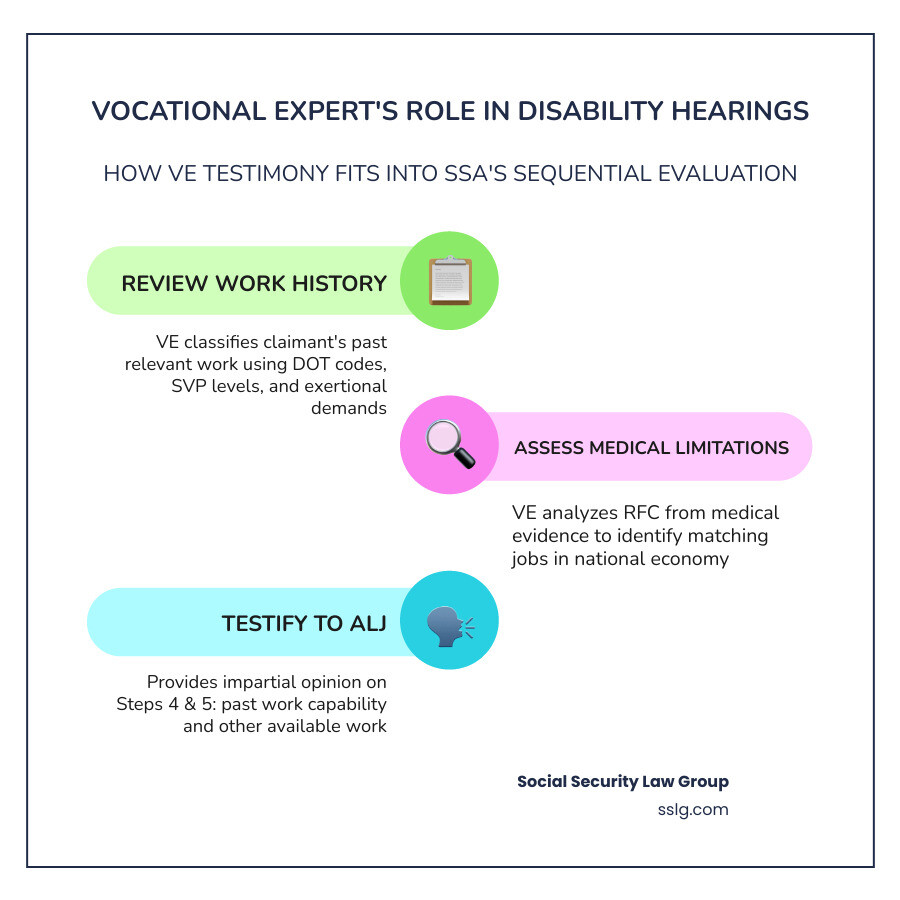
The VE’s input is primarily focused on Step 4 and Step 5:
- Step 4: Can you perform your “past relevant work”? The VE looks at your work history from the last 15 years. If the VE testifies that a person with your limitations can still do your old job, your claim will be denied.
- Step 5: Can you perform “other work”? If you can’t do your old job, the ALJ asks the VE if there are other jobs in the national economy you can do, considering your age, education, and work experience. This is where the VE must cite specific job titles and the number of those jobs available.
For our clients in major hubs like Los Angeles, San Diego, or Las Vegas, the VE must identify jobs that exist in “significant numbers” in the national economy. This doesn’t mean the job has to be across the street from your house, but it must be a real-world occupation that a person with your Residual Functional Capacity (RFC) could reasonably perform.
Classifying Past Relevant Work and the Dictionary of Occupational Titles (DOT)
The VE’s first task is to classify your past work using the Dictionary of Occupational Titles (DOT). The DOT is a massive publication by the Department of Labor that assigns a nine-digit code to over 13,000 types of jobs.
Each job in the DOT is categorized by:
- Exertional Level: How much lifting, carrying, standing, and walking is required.
- SVP (Specific Vocational Preparation): How long it takes to learn the job. Unskilled work is typically SVP 1 or 2 (learned in 30 days or less), while skilled work is SVP 5 through 9.
| Exertional Level | Lifting Limit | Standing/Walking Requirement |
|---|---|---|
| Sedentary | 10 lbs maximum | ~2 hours of an 8-hour day |
| Light | 20 lbs maximum | ~6 hours of an 8-hour day |
| Medium | 50 lbs maximum | ~6 hours of an 8-hour day |
The SSA uses these definitions under 20 CFR 404.1567. A common issue we see is a VE classifying a past job as “light” because that is how the DOT describes it, even if our client actually performed it at a “heavy” level. This distinction is vital for ssa-grids—the medical-vocational rules that can lead to an automatic approval for those over age 50 or 55.
Navigating Hypothetical Questions and “Killer Limitations”
The most famous part of a disability hearing is the “hypothetical question.” The ALJ will ask the VE: “Assume an individual of the claimant’s age, education, and work experience, who is limited to [X, Y, and Z limitations]. Could such an individual perform the claimant’s past work or any other work in the national economy?”
The ALJ usually asks several versions of this question, starting with very few limitations and gradually adding more. We pay close attention to these because the final hypothetical often represents what the judge actually believes your limitations are.
Identifying “Killer Limitations”
Based on Social Security Administration vocational guidelines and hearing precedents, certain “killer limitations” have been identified that, if accepted by the VE, usually eliminate all possible jobs. These are often non-exertional or mental limitations that the DOT doesn’t always cover well. Examples include:
- Off-Task Time: If a person is “off-task” for more than 10-15% of the workday (due to pain, bathroom breaks, or lack of concentration), most VEs testify that all work is precluded.
- Absenteeism: If an individual would miss more than one or two days of work per month on a consistent basis, there are generally no jobs available.
- Lying Down: Needing to lie down or recline outside of normal break times (lunch and two 15-minute breaks) is a job-killer.
- Postural/Manipulative Limits: For sedentary jobs, if you cannot use your hands “frequently” for reaching, handling, or fingering, the list of available jobs shrinks to almost zero.
If you are worried about how to answer these types of inquiries, you can read more about disability hearing questions and how to avoid disability judge trick questions on our blog.
Strategies for Challenging Vocational Expert Testimony
One of the biggest problems in Social Security law today is that the Dictionary of Occupational Titles (DOT) hasn’t been fully updated since 1977. This means VEs often testify about jobs like “Addresser” or “Document Preparer” that involve outdated technology or simply don’t exist in the modern economy.
The SSA recently issued Emergency Message (EM)-24027 REV, which acknowledges that certain DOT occupations are obsolete. If a VE cites a job from this list, the ALJ must ask the VE to explain how that job is performed today using their professional experience. This is a major opening for a skilled attorney to challenge the testimony.
Effective Cross-Examination of Vocational Expert Testimony
We don’t just sit back and listen to the VE. We use several strategies to protect your rights:
- Challenging Job Numbers: VEs often use the U.S. Bureau of Labor Statistics OEWS data, but that data uses the SOC (Standard Occupational Classification) system, not the DOT. Because one SOC code can contain dozens of DOT codes, the VE’s estimate of how many “Nut Sorters” exist in the country is often a guess. We challenge the methodology used to reach these numbers.
- Highlighting Conflicts: Under SSR 00-4p, if a VE’s testimony conflicts with the DOT, they must provide a reasonable explanation. If they say a “Light” job can be done by someone who must sit all day, that’s a conflict we will expose.
- Adding Limitations: If the ALJ’s hypothetical was too “easy,” we will ask our own. “Mr. Expert, if the individual also required a sit-stand option at will, would those three jobs still remain?” Often, the answer is “No.”
Preparing for Vocational Expert Testimony at Your Hearing
Preparation is the key to winning a disability hearing. For our clients in cities like San Antonio, Seattle, or Detroit, we spend time reviewing your work history in detail. If the VE misclassifies your past work, we need to be ready to correct them immediately.
We also ensure your medical evidence supports the “killer limitations” mentioned earlier. If your doctor has stated you need to elevate your legs or take unscheduled breaks, that evidence gives us the ammunition we need to eliminate the jobs the VE suggests.
Frequently Asked Questions about Vocational Experts
What happens if the vocational expert says I can do three jobs?
Don’t panic! This is a standard part of the hearing. It means the VE has identified three examples of work that fit the ALJ’s hypothetical profile. However, if your attorney can show that you have additional limitations—like needing to be off-task or having limited use of your hands—those three jobs may disappear. Even if the jobs remain, the ALJ still has to make the final decision based on the entire record.
Can I object to the vocational expert’s qualifications?
Yes. While it is rare for a VE to be completely unqualified, you have the right to object if their resume is missing or if they lack experience in the specific labor market being discussed. In most cases, it is more effective to challenge the substance of their testimony rather than their resume.
Why does the VE use the Dictionary of Occupational Titles if it is outdated?
The SSA is currently developing a new Occupational Information System (OIS), but until it is fully implemented, the DOT remains the primary source. Because it is so old, it is vital to have an attorney who knows how to use Emergency Message (EM)-24027 REV to argue that the jobs being cited are obsolete.
Conclusion
The presence of a vocational expert at your hearing can be intimidating, but their testimony is just one hurdle on the path to your benefits. Whether you are attending a hearing in Denver, Houston, or Charlotte, the goal remains the same: proving that your medical conditions prevent you from engaging in substantial-gainful-activity.
At Social Security Law Group, we have been fighting for claimants since 1994. We apply our extensive knowledge of Social Security Administration regulations and vocational policy to handle vocational expert testimony. We operate on a no-win, no-fee basis, meaning you don’t pay us unless we win your case.
If you are preparing for a hearing or have been denied benefits, don’t go it alone. Contact our California disability lawyers for a free consultation or reach out to us at any of our locations across the country, including Las Vegas, Phoenix, and Chicago. We are here to ensure the vocational evidence in your case is fair, accurate, and challenged whenever necessary.