

Why Understanding Your SSI Payment Schedule Matters
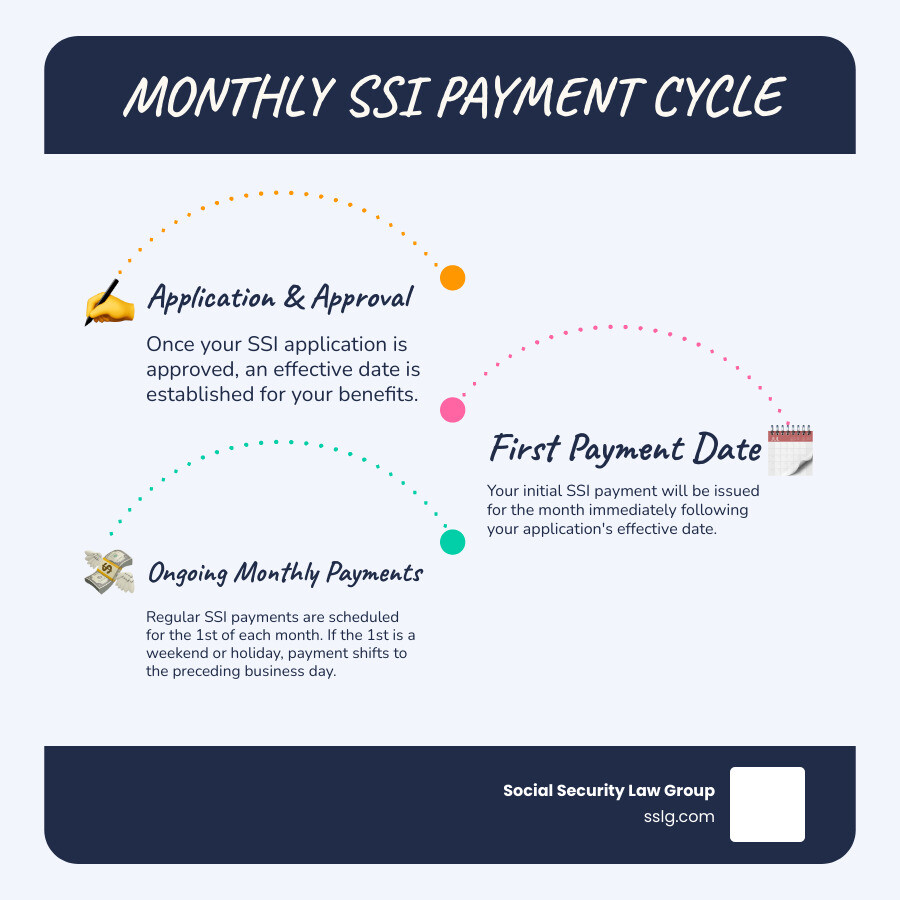
SSI check dates follow a straightforward schedule: payments arrive on the 1st of each month for recipients who only receive Supplemental Security Income. However, if the 1st falls on a weekend or federal holiday, your payment arrives on the preceding business day.
Here’s the quick reference guide:
| Your Situation | Payment Date |
|---|---|
| SSI only | 1st of each month (or last business day before) |
| SSI + Social Security (both programs) | SSI on 1st, Social Security on 3rd |
| Started benefits before May 1997 | 3rd of each month |
| First payment after approval | 1st of month after application effective date |
If you receive Supplemental Security Income, knowing exactly when your payment arrives is critical for managing rent, utilities, medications, and other essential expenses. Unlike Social Security Disability Insurance (SSDI), which uses a birthdate-based schedule, SSI follows a simpler pattern.
The reality is stark: when you’re living with a disability and unable to work, every dollar counts. Missing a payment or miscalculating when funds will arrive can mean the difference between keeping the lights on or facing disconnection notices.
This guide breaks down everything you need to know about SSI payment dates—from understanding the standard schedule to navigating holidays, calculating your first payment after approval, and troubleshooting late deposits. We’ll also explain how SSI differs from SSDI, what happens if you receive both benefits, and when redeterminations might affect your payments.
Whether you’re waiting for your first SSI check or simply want to plan your monthly budget more effectively, understanding the payment calendar removes one layer of stress from an already challenging situation.
Understanding the Standard SSI Payment Schedule
For the vast majority of our clients, the most important date on the calendar is the 1st of the month. If you are an SSI-only recipient, the Social Security Administration (SSA) designs the system so that your Supplemental Security Income is available right as the month begins. This helps ensure that rent and other early-month bills can be paid on time.
While the SSA still mails paper checks to some individuals, they strongly encourage electronic deposits. Most SSI Benefits are now delivered via direct deposit to a bank account or through the Direct Express® Debit Mastercard. Electronic payments are generally faster and safer than waiting for the mail, especially since paper checks are subject to transit delays or theft.
Determining Your First Payment After Approval
One of the most common questions we hear at Social Security Law Group is, “When will I actually see my first check?” The answer depends on your “application effective date.”
Under the law, SSI payments cannot begin until the month after you apply or the month after you first become eligible. For example, if you file your application on September 15th and meet all SSI Qualifications, your application effective date is October 1st. Consequently, your first payment would arrive in November.
This is why “protective filing” is so important. A protective filing date is established the moment you first contact the SSA to express your intent to file for SSI Disability. This date “locks in” your eligibility window. Even if it takes you a few weeks to gather your documents and officially submit the paperwork, your benefits are calculated based on that initial contact date.

How Holidays and Weekends Affect SSI Check Dates
The SSA follows a strict rule: you should never receive your payment later than the 1st of the month. To make this happen, they use a “preceding business day” rule.
If the 1st of the month falls on a Saturday, Sunday, or a federal holiday, your ssi check dates are moved up. For instance, if the 1st is a Sunday, your payment will typically be deposited on the preceding Friday. This ensures you have your funds before the weekend begins.
It is important to remember that banking holidays also play a role. Even if the SSA sends the money, your specific bank must process it. Most major banks in our service areas—from Miami and Tampa to Detroit and Denver—comply with the SSA’s schedule, but it’s always wise to check your bank’s specific policy regarding holiday fund availability. You can find more details on the 2025 Social Security Schedule to see exactly how these shifts play out.
2025 and 2026 Payment Adjustments
Every year, the SSA evaluates the Cost-of-Living Adjustment (COLA) to ensure benefits keep up with inflation. For 2025, recipients saw a 2.5% boost. This means the maximum federal SSI payment increased from $943 in 2024 to $967 for individuals in 2025. Couples saw their maximum jump to $1,450.
Looking ahead, early estimates for 2026 suggest a COLA increase of approximately 2.8%. While this isn’t as high as the massive 8.7% jump seen in 2023, it still provides a necessary buffer against rising costs. The SSA has already published the 2026 schedule for benefit payments, which includes several “double payment” months (like January and August) where the following month’s check is sent early due to the 1st falling on a weekend.
SSI vs. SSDI: Comparing Payment Timelines
Many people confuse SSI with Social Security Disability Insurance (SSDI), but their payment schedules are very different. SSDI payments are usually staggered throughout the month based on your birthday.
| Birthday Falls On | SSDI Payment Date |
|---|---|
| 1st – 10th | Second Wednesday |
| 11th – 20th | Third Wednesday |
| 21st – 31st | Fourth Wednesday |
What is the difference between SSI and SSDI? While SSDI is based on your work history and Social Security taxes paid, SSI is a needs-based program for those with limited income and resources. Because they are funded differently, they follow these distinct cycles.
ssi check dates for Dual Recipients
What happens if you are eligible for both programs? If you receive “concurrent benefits,” your ssi check dates shift slightly to help you manage your cash flow.
For dual recipients, the SSA typically pays the SSI portion on the 1st of the month and the Social Security (SSDI/Retirement) portion on the 3rd of the month. This same “3rd of the month” rule applies if you began receiving Social Security benefits before May 1997. Can you get SSDI and SSI at the same time? Yes, and millions of Americans do. We often help clients steer the complexities of receiving both to ensure they are getting the maximum amount allowed by law.
Managing Your Benefits: Redeterminations and Back Pay
Receiving your check is only half the battle; keeping it requires staying in compliance with SSA rules. The SSA periodically conducts “redeterminations” to review your non-medical eligibility.
During a redetermination, the SSA looks at your income, resources, and living arrangements. This usually happens every 1 to 6 years. If you get married, move in with a friend who pays for your food, or receive an inheritance, you must report these changes. Failure to respond to a redetermination request within 30 days can lead to your payments being stopped or even an overpayment notice that you’ll have to pay back later. You can read the official rules on Redeterminations | Supplemental Security Income (SSI) | SSA. If you face a cessation of benefits, an SSI Appeal Lawyer from our team can help you fight to reinstate them.
Calculating SSI Back Pay
Because the disability application process can take months (or even years), most people are entitled to back pay once they are finally approved.
For SSI, back pay is relatively simple: you are paid for the months between your application date (or protective filing date) and your approval date. Unlike SSDI, which has a five-month waiting period, SSI back pay starts accruing the month after you apply. This is often paid as a lump sum, though very large amounts may be split into three installments paid six months apart. If you’re wondering how much does SSDI or SSI pay?, our experts can provide a personalized estimate based on your specific financial situation.
Troubleshooting Late Payments and Schedule Changes
It is a sinking feeling when the 1st of the month arrives and your bank balance hasn’t changed. If your payment is late, don’t panic.
If you use direct deposit or a Direct Express card, first contact your financial institution. Sometimes there is a delay in their internal processing. If you still receive a paper check in the mail, the SSA asks that you wait three additional mailing days before reporting it missing.
To stay ahead of issues, we highly recommend creating a mySocialSecurity account. This portal allows you to check your payment status, update your address, and manage your direct deposit information instantly. If your benefits are suspended entirely, you’ll need to know How to Reinstate SSI Benefits through the proper administrative channels.
Can You Change Your SSI Check dates?
We are often asked if a recipient can move their payment date to later in the month to align with a specific bill. Unfortunately, the answer is generally no.
The SSA uses a fixed, automated system to process millions of payments. While there are some very rare “voluntary cycling” options for those on the birthdate-based SSDI schedule, SSI dates are set in stone on the 1st of the month. You can find more on this in the SSA’s FAQ: Can I change the date I receive my benefits?.
Frequently Asked Questions about SSI Check Dates
When are SSI checks mailed versus direct deposited?
Direct deposits are usually available by the morning of the 1st (or the preceding business day). Paper checks are mailed through the U.S. Postal Service and are intended to arrive on the same day, though they are much more susceptible to delays.
What should I do if my SSI payment is late?
- Check the calendar to see if it was a weekend/holiday (you might have actually received it early!).
- Contact your bank or Direct Express.
- If it’s a paper check, wait three business days.
- Call the SSA at 1-800-772-1213 or visit your local office in cities like St. Louis, Jacksonville, or Detroit.
How does the SSA determine the maximum SSI benefit amount?
The maximum amount is set by federal law and adjusted annually via the COLA. For a deep dive into the specific rates, see our guide on SSI Amounts for 2024. Your actual payment may be lower if you have other “countable income” or if you receive free room and board from someone else.
Conclusion
Navigating ssi check dates and Social Security regulations can feel like learning a second language. Between COLA increases, weekend adjustments, and the nuances of back pay, there is a lot to keep track of.
At Social Security Law Group, we’ve been helping people just like you since 1994. Whether you are in Boston, Las Vegas, or San Antonio, our mission is the same: to provide unrivaled legal representation with a 97% success rate. We operate on a no-win, no-fee structure, meaning we only get paid if we successfully secure your benefits.
Don’t leave your financial future to chance. If you have questions about your SSI Payment Schedule or need help with an initial application or appeal, reach out to us today. We have the technology and the expertise to handle your claim with the care it deserves.