

This content speaks exclusively to disabled Americans who are presently receiving benefits under a Short-Term or Long-Term Disability plan provided by their employer.
As you read on, there is one overarching theme and take away that we would like you to remember, and it is this:
While the language baked into your Long-Term Disability Plan requires you to make diligent pursuit of Social Security Disability Benefits, the choice of who will represent you, if anyone, is 100% yours and yours alone.
By now, your LTD Insurer (LTD Carrier) may have already been in contact with you about pursuing Social Security. If they haven’t talked about it with you on the phone or addressed it in correspondence, they soon will. We want to make sure that you completely understand that you are legally authorized to initiate and go through the SSDI claim process on your own, or with assistance of your choosing. For many of the reasons we stated in other sections of this website, we absolutely do not recommend that you pursue this process alone.
Your LTD Carrier may have already set you up with a “vendor” who can assist you in this process. Although that choice is yours, we want to let you know that we too are here to assist you in pursuit of a Social Security Disability Claim, and can provide every service or update that your Carrier may need or require. In fact, your chances of winning are better with us than with any vendor you’ll be paired-up with by your insurer. Keep reading!
If they want periodic updates regarding the status of your claim, we have an authorization that you sign allowing us to keep them updated as often as they want. If they want access to your claim profile in Status Star, we can give you a different authorization allowing this as well. This is important because, in 2019 the Department of Labor (DOL) issued new regulations as it relates to the interplay of Social Security and Long-Term Disability.
When your LTD claim reaches the Any Occupation phase and we can explain that in detail, your Carrier must account for the SSDI outcome in their analysis. If your Carrier desires, our technology will keep them in compliance with those DOL Regulations. In short, and at each step, we can provide you with competent Attorney Legal representation while keeping you in full compliance with your LTD Plan language.
Receiving long-term disability benefits does not automatically qualify you for Social Security Disability benefits.
While the two programs often overlap, each has its own eligibility requirements, evidence standards, and claims process. Understanding how they work together can help you avoid mistakes and maximize the benefits available to you. Because decisions in one claim can affect the other, many applicants choose to seek legal guidance when pursuing both benefits.
How so? If you are approved for Social Security, and the Agency pays you a lump sum, our fee is credited from the amounts you will owe back to the LTD Carrier under the terms your Plan language. They call this your LTD Plan overpayment. We discuss this in greater detail below.
Although occasionally a Client receiving LTD benefits has told us that LTD staff informed them that they would not cover our fee, this is simply not accurate. In our firm’s 28-years of representing disabled individuals for Social Security Disability benefits, many thousands have been referred to us by insurance carriers. And in all that time, we have never – not even once – had an insurer refuse to pay for our services, and for good reason.
As an American, you have the right to representation of your choosing, and such a statement or any action anyone takes to impede or frustrate that right, would be contrary to insurance regulations in all 50 states. In fact, when LTD Carriers refer clients to us, we ensure that the individual making the referral is made aware that our involvement in the LTD claim is voluntary based on the Client’s decision. If such a restrictive statement has been made to you by any LTD Carrier’s staff, you should call us and let us know.
Here are a few additional things to consider. First, we have been representing disabled Americans who are receiving Long-Term Disability since 1994. Second, we have been in this LTD market for 28 years, and presently work with several LTD Carriers right now. We know each and every ‘advocacy company’ that markets themselves to the LTD Carriers.
Additionally, you want to make sure that you completely understand whether or not the “vendor services” you’re being offered are Attorneys or non-attorney “advocates”. It’s very simple to verify. They have or should be sending you a form called an SSA-1696 (Appointment of Representative). This signed document is required by Social Security Regulations before you can actually have someone assist you in your Social Security claim.
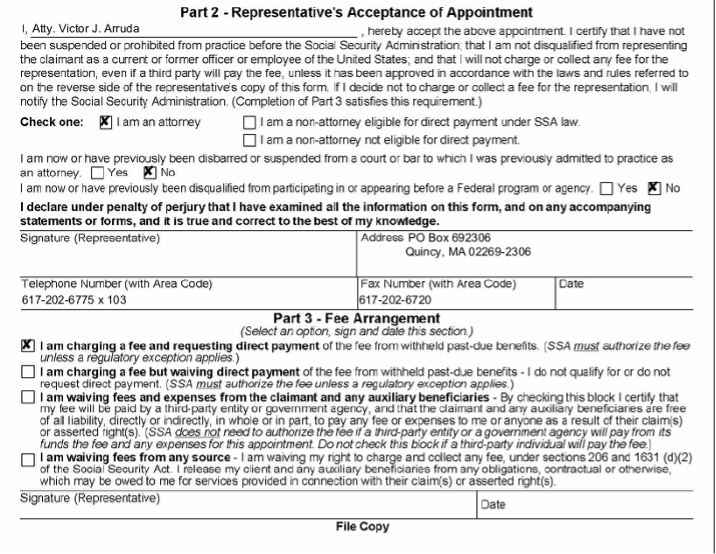
In August of 2020, the Agency updated the SSA-1696. We will show you the old version and the current version of the form. If you can, stop here to take a moment to look for the SSA-1696.
In the old version of the form which may still be in circulation (below), that question is answered in Part 2 of the 1696. As you can see, the Social Security Law Group is a Law Firm comprised of Attorneys who provide Legal Services. If the “vendor” that your LTD Carrier is recommending has sent you a 1696, check Part 2. If the Attorney box is not checked, then by definition, they are non-attorney “advocates”. It would be a violation of SSA Regulations and state Bar rules to check the Attorney box if one is not a Licensed Attorney. We didn’t pay thousands of dollars and endure 3+ years of hard work to have it diluted by checking a box.
In the new 2020 version of the form, you’ll find the answer to that same question in Section 5:
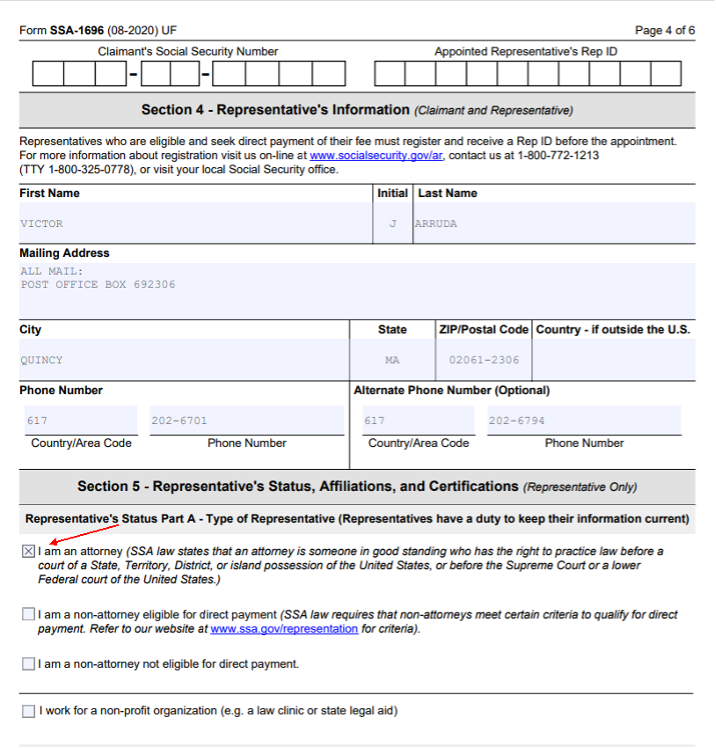
What’s the difference you might ask? The difference is gargantuan! While the SSA regulations allow non-attorneys to represent clients before Social Security and collect a fee from your Past Due benefits, our skill, preparation, knowledge, and respect from the ALJ’s cannot be matched, plain and simple.
The Social Security Law Group has one of the best reputations throughout the SSA, DDS’s and OHOs. The companies in this space know it, and we do too. In addition, as Attorneys, you are granted additional rights and protections by your state’s laws as they relate to the Attorney-Client relationship. Those same laws do not apply to non-attorney “advocates”.
Let’s take the fee arrangement as a prime example, you’ll also find the fee arrangement in that same 1696 Form. In the previous version, it is contained in Part 3.
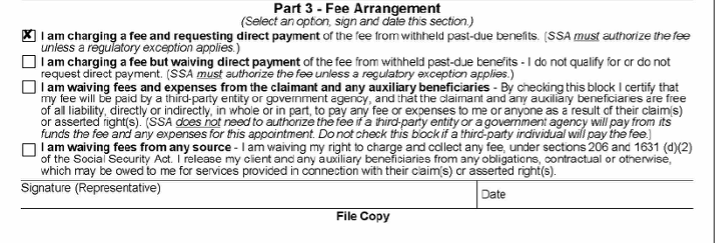
As you can see above, our fee is paid by the Social Security Administration. It must be first approved by the Agency and then it’s sent to us. You then receive the remainder of your Past Due Benefits. When your LTD Carrier sends you an invoice for your overpayment, they will deduct the amount that we’ve been paid from what you owe them. (See illustration 4)
In many cases, the “vendor” that your Carrier is recommending will be checking the third box down (3). This means that the Agency will release all the Past Due Benefits to you, and then you will owe the money back to the Carrier. The vendor will either send the Carrier an invoice for their services, or they will offer to recover your overpayment and remove the agreed-upon fee prior to sending the remainder of the funds back to your LTD carrier.
As attorneys, if we were to make such an arrangement with your LTD Carrier, we are required by regulation to explicitly and clearly disclose these details to you, our Client. The regulations requiring this disclosure is for your benefit. Non-attorney “advocates” have no such requirement. In addition, if we assist you with any repayment efforts back to your Carrier, other States’ Bar Regulations require us to do this through our Client Trust Fund Account (IOLTA). These accounts are certified by the state and heavily regulated by the state Bar Associations in all 50 states. These regulations are also for your protection. Once again, non-attorney “advocates” have no such requirement.
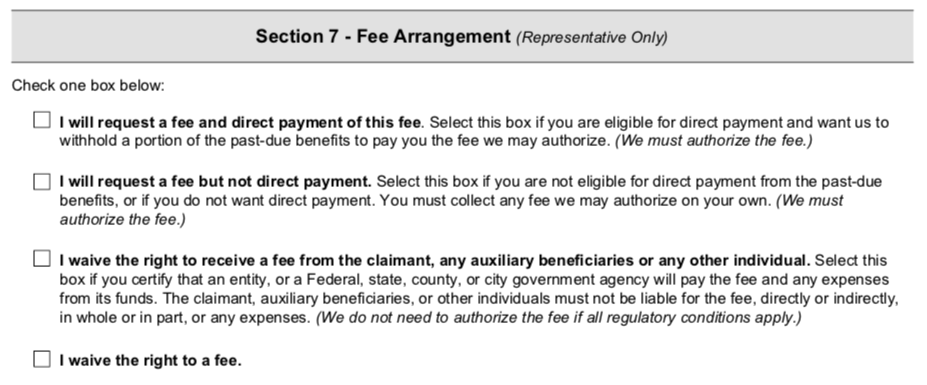
In the August 2020 version of the Form-1696, you’ll find that arrangement in Section 7.