

What You Need to Know About Spinal Cord Injury and Disability Benefits
Spinal cord injury is damage to the bundle of nerves that runs through your spine and carries signals between your brain and the rest of your body. When those signals are disrupted, the effects can be life-changing.
Here is a quick overview of what a spinal cord injury means for disability eligibility:
- It can qualify for Social Security disability benefits under the SSA Blue Book, including Section 11.04 (spinal cord disorders)
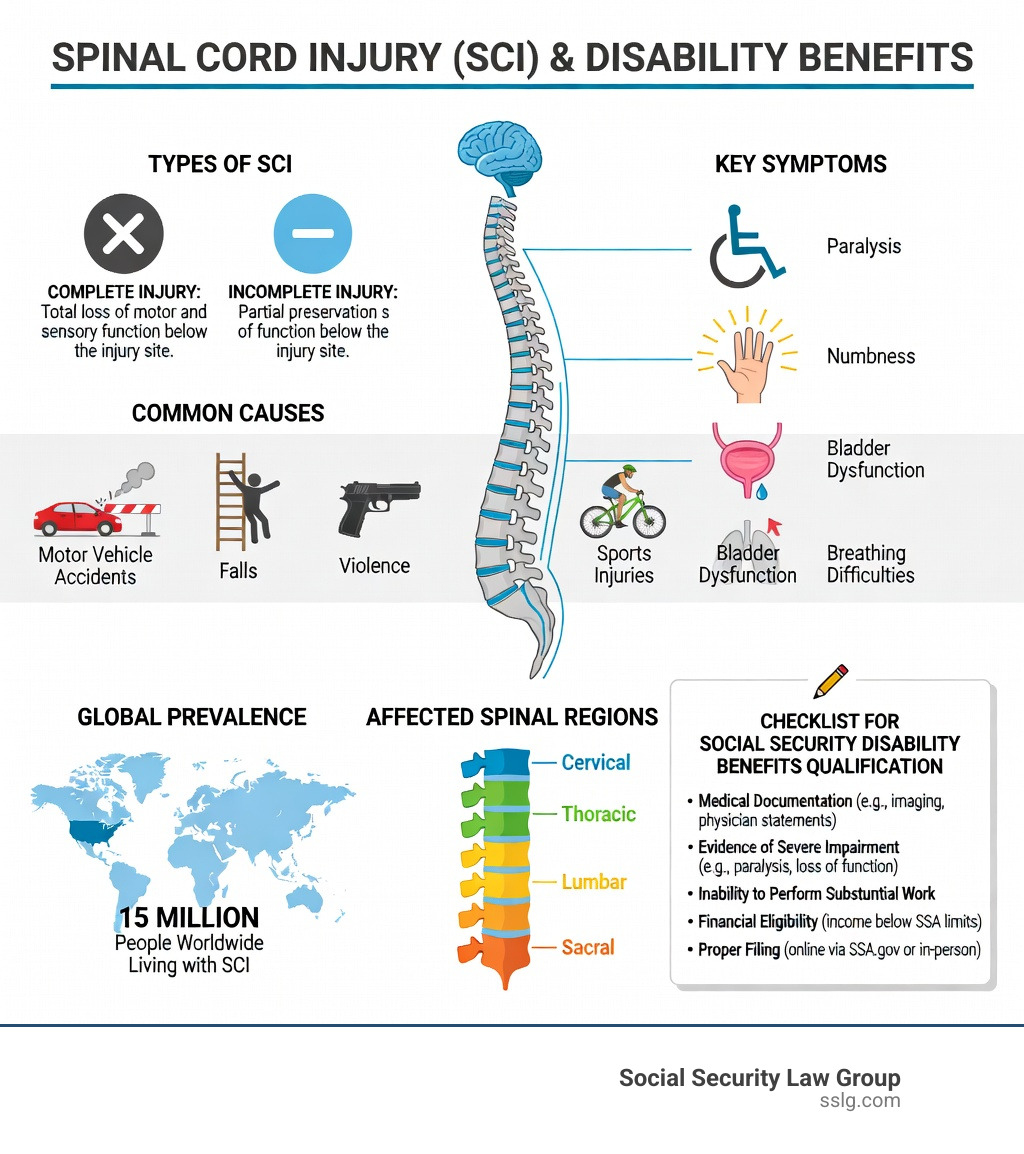
- Complete injuries cause total loss of movement and feeling below the injury site
- Incomplete injuries allow some function to remain below the injury site
- Common causes include car accidents, falls, violence, and sports injuries
- Key symptoms include paralysis, numbness, bladder and bowel problems, and breathing difficulties
- Medical documentation is essential to support a disability claim
According to the World Health Organization, over 15 million people worldwide are currently living with a spinal cord injury. In the United States alone, the National Spinal Cord Injury Statistical Center reports approximately 18,000 new cases every year.
The physical toll is severe. But the financial toll can be just as devastating. Many people with a spinal cord injury are unable to work, and navigating the Social Security disability system while managing a serious injury is overwhelming.
This guide explains everything you need to know about spinal cord injuries and how to qualify for disability benefits. Whether you are in Los Angeles, San Diego, Sacramento, San Francisco, or anywhere else in the country, understanding your rights is the first step.
Defining Spinal Cord Injury and Its Primary Causes
A spinal cord injury (SCI) occurs when there is damage to the spinal cord itself or the spinal nerves at the base of the spinal canal. This bundle of nerves is the “information superhighway” of the central nervous system. When the vertebrae (the bones surrounding the cord) are fractured or dislocated, they can compress, tear, or crush the nerve fibers.

The causes of these injuries are generally categorized into two groups: traumatic and non-traumatic.
Traumatic SCI
These are the result of a sudden, external physical impact. According to the National Spinal Cord Injury Statistical Center (NSCISC), the leading causes in the United States include:
- Motor Vehicle Accidents: This is the top cause of SCIs, accounting for nearly 38 percent of new cases each year.
- Falls: This is the most common cause for individuals over the age of 65.
- Acts of Violence: Gunshot wounds and assaults cause approximately 12 percent of injuries.
- Sports and Recreation: High impact sports and diving into shallow water account for about 10 percent of cases.
Non-Traumatic SCI
These injuries result from internal factors such as diseases or cellular damage. Common examples include tumors, infections like meningitis, arthritis, and degenerative disc disease. Research from the National Institute of Neurological Disorders and Stroke (NINDS) highlights that inflammation and internal pressure can be just as damaging to nerve transmission as a physical blow.
Who is at Risk?
Statistics show that 78 percent of new spinal cord injury cases involve males. The average age at the time of injury has increased over the years and currently sits at 43. Risk factors often include engaging in risky physical behaviors, not wearing seatbelts, or underlying bone conditions like osteoporosis.
Types and Symptoms of a Spinal Cord Injury
The severity and location of the injury dictate the symptoms a person will experience. Doctors use specific terms to describe the extent of the damage.
Complete vs. Incomplete Injuries
The distinction between these two types is vital for both medical prognosis and disability applications.
| Feature | Complete Injury | Incomplete Injury |
|---|---|---|
| Nerve Signals | All signals are blocked below the injury site. | Some signals still travel between the brain and body. |
| Sensation | Total loss of feeling below the level of injury. | Partial feeling or “patchy” sensation remains. |
| Motor Function | Total paralysis below the injury site. | Some ability to move muscles remains. |
| Sacral Sparing | No feeling or muscle control in the lowest sacral segments. | Preservation of some function in the sacral area. |
Paralysis Categories
The “level” of the injury refers to the segment of the spine where the damage occurred.
- Tetraplegia (Quadriplegia): This results from injuries to the cervical spine (neck). It affects the arms, legs, trunk, and pelvic organs.
- Paraplegia: This affects the lower half of the body, usually resulting from injuries in the thoracic, lumbar, or sacral regions of the spine.
Symptoms often extend beyond the loss of movement. Many individuals experience autonomic dysreflexia (a dangerous spike in blood pressure), muscle spasticity, and chronic pain. According to the World Health Organization, secondary complications like bladder and bowel dysfunction are nearly universal among those living with SCI.
Emergency Signs of a Spinal Cord Injury
If you suspect someone has suffered a back or neck injury, immediate medical attention is mandatory. The Mayo Clinic First Aid Guide identifies several emergency warning signs:
- Extreme back pain or pressure in the neck and head.
- Weakness, incoordination, or paralysis in any part of the body.
- Numbness or tingling in the hands, fingers, feet, or toes.
- A twisted or oddly positioned neck or back.
- Difficulty with balance or walking.
- Impaired breathing after an accident.
Long Term Complications of a Spinal Cord Injury
The initial injury is often just the beginning of a lifelong health journey. Secondary medical conditions can be life-threatening if not managed. The Christopher and Dana Reeve Foundation provides extensive resources on managing these risks, which include:
- Pressure Ulcers: Also known as bedsores, these occur due to a lack of movement and can lead to severe infections.
- Deep Vein Thrombosis (DVT): Blood clots in the legs that can travel to the lungs.
- Pneumonia: A leading cause of death for those with high level injuries that affect breathing muscles.
- Muscle Atrophy and Bone Density Loss: The body weakens when muscles are not in use.
- Depression: The psychological impact of a sudden disability is profound.
Diagnosis and Immediate Treatment Protocols
When a patient arrives at an emergency room with a suspected spinal cord injury, speed is of the essence. The diagnostic process usually begins with a physical and neurological examination to check sensory function and muscle strength.
Imaging Technology
Modern medicine relies on several types of scans to see what is happening inside the spinal column:
- X-ray: Used primarily to look for obvious fractures or tumors.
- CT Scan: Provides a better look at the shape and structure of the spinal canal.
- MRI: The “gold standard” for SCI. According to PubMed research, MRI is essential for seeing the spinal cord itself, as well as identifying blood clots or herniated discs that might be pressing on the nerves.
Immediate Care
The first goal is stabilization. This involves immobilization of the spine to prevent further damage. In some cases, doctors may administer high dose steroids like methylprednisolone within the first eight hours of injury to reduce inflammation, though this remains a debated practice.
Surgical intervention may be necessary for spinal stabilization or surgical decompression. This involves removing bone fragments or foreign objects that are compressing the cord. Following surgery, patients are typically moved to an intensive care unit for close monitoring of heart rate, blood pressure, and lung function.
Ongoing NINDS research continues to look for ways to stop the “secondary injury” phase, which is the wave of cell death that follows the initial trauma.
Qualifying for Social Security Disability with a Spinal Cord Injury
For many of our clients, the most pressing concern after a spinal cord injury is how they will support themselves. The Social Security Administration (SSA) has strict rules for what qualifies as a disability.
The Blue Book Listings
The SSA uses a manual called the Blue Book to evaluate claims. There are two primary sections where an SCI might be evaluated:
- Section 1.04 (Musculoskeletal Disorders): This is used if the injury involves the spinal column, such as a herniated disc or spinal stenosis, resulting in compromised nerve roots.
- Section 11.04 (Neurological Disorders): This specifically addresses “spinal cord disorders.” To qualify here, you must demonstrate a complete loss of function in any part of the body or “disorganization of motor function” in two extremities that results in an extreme limitation in the ability to stand up from a seated position, balance while standing or walking, or use the upper extremities.
Regional Support and Legal Requirements
At Social Security Law Group, we understand that the process can feel different depending on where you live.
- California disability claims: If you are filing in the Golden State, our team can help you navigate the specific state disability insurance (SDI) overlaps.
- Los Angeles and San Francisco: These regional offices handle massive volumes of claims. Having a well organized file is the only way to ensure you don’t get lost in the shuffle.
- San Diego and Sacramento: In these areas, we emphasize the collection of specific medical evidence. The SSA wants to see more than just a diagnosis; they want to see how the injury limits your daily life.
- San Antonio and Dallas: Our representatives in Texas focus on vocational factors, which are especially important for applicants over the age of 50.
Required Medical Documentation
To build a strong case, you will need:
- Detailed reports of your initial neurological exam.
- Imaging results (MRI, CT scans).
- Records of all surgeries and hospitalizations.
- A list of all medications and their side effects.
- Physical and occupational therapy progress notes.
- A statement from your doctor regarding your physical limitations.
Rehabilitation and Recovery Prognosis
Rehabilitation is the cornerstone of life after a spinal cord injury. While the damage to the cord is often permanent, the body and brain have a remarkable ability called neuroplasticity, which allows for some adaptation.
The Rehab Team
Rehabilitation is a multidisciplinary effort. Physical therapy focuses on strengthening available muscles and maintaining range of motion. Occupational therapy helps patients relearn daily tasks like dressing or grooming. For those in our Denver or Phoenix locations, we often recommend centers that specialize in functional electrical stimulation (FES), which uses small electrical pulses to trigger muscle movements.
Assistive Technology
Technology has changed what is possible for those with an SCI. This includes:
- Customized power wheelchairs.
- Voice activated home systems.
- Exoskeleton technology: Wearable robotic suits that allow some individuals with paraplegia to stand and walk.
- Neural prosthetics: Devices that can bridge the gap in damaged nerve pathways.
The Future of Recovery
The World Health Organization emphasizes that rehabilitation should be an ongoing process, not just a one time event. Research is currently booming in areas like stem cell therapy and spinal cord stimulation. You can find a list of active studies and clinical trials for SCI recovery to see the latest advancements in the field.
Frequently Asked Questions about Spinal Cord Injury
Can I work with a spinal cord injury?
Yes, many people with an SCI return to the workforce. This often involves vocational rehabilitation to learn new skills or finding reasonable accommodations for sedentary work. Programs like the SSA’s “Ticket to Work” allow you to test your ability to work without immediately losing your benefits. In California, employment support programs are particularly robust for those with physical disabilities.
How is the severity of a spinal cord injury determined?
The medical community uses the ASIA Impairment Scale (AIS). This scale, developed by the American Spinal Injury Association, grades injuries from A to E based on how much sensation and motor function remains.
- Grade A: Complete injury.
- Grade E: Normal motor and sensory function.
What resources are available for residents in our service areas?
Depending on your location, there are several specialized resources available:
- Sarasota and Tampa: Local medical centers offer advanced physical therapy programs.
- St. Louis and Chicago: These cities host some of the nation’s premier research hospitals for spinal cord disorders.
- Seattle and Atlanta: Disability advocacy groups in these regions are very active in helping residents secure accessible housing and transportation.
- Charlotte and Raleigh: Community resources here provide vital assistance with peer support groups and adaptive sports leagues.
Conclusion
A spinal cord injury is a life altering event, but it does not have to mean the end of your financial security. At Social Security Law Group, we have provided expert legal representation for disability claims since 1994. With a 97 percent success rate and a no win, no fee structure, we are dedicated to helping you get the benefits you deserve.
Our team uses modern client technology to make the application process as smooth as possible, whether you are in Las Vegas, Detroit, Jacksonville, or Houston. We handle the paperwork and the SSA so you can focus on your recovery.
If you are ready to take the next step, we are here to help. Contact us today to learn more about how our unrivaled expertise can work for you.