


What is Substantial Gainful Activity (SGA)?
SGA social security refers to the monthly earnings limit the Social Security Administration (SSA) uses to decide if you are disabled enough to receive benefits. If you earn above this limit, the SSA considers you able to work and may deny or stop your benefits.
Here is a quick overview of the key SGA facts for 2025:
| Category | 2025 Monthly SGA Limit |
|---|---|
| Non-blind disabled individuals | $1,620 |
| Statutorily blind individuals | $2,700 |
| Trial Work Period threshold | $1,110 |
| Maximum SSI payment (individual) | $967 |
These limits are adjusted every year based on national wage data. The SSA updates SGA amounts annually to keep pace with changes in average wages across the country.
If you are applying for Social Security Disability Insurance (SSDI) or Supplemental Security Income (SSI), understanding SGA is critical. Earning too much in any given month can pause or end your benefits, even if your medical condition has not changed.
The rules around SGA are more complex than a simple income cutoff. The SSA looks at the type of work, your net countable earnings after deductions, employer subsidies, and whether your work was a genuine attempt at returning to employment. Getting these details wrong can cost you benefits you are entitled to.
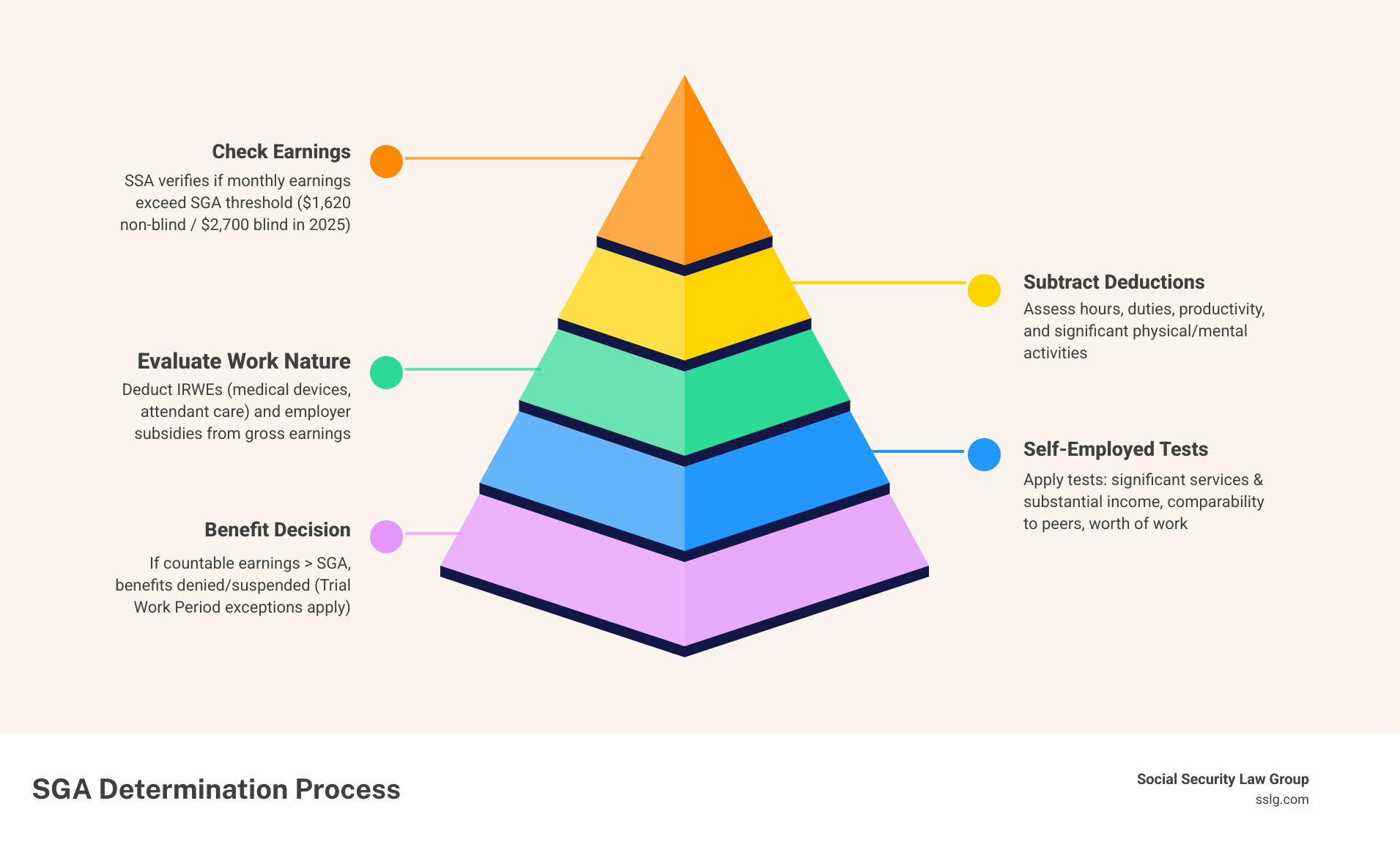
At its core, Substantial Gainful Activity is a metric used by the government to determine if a person’s work activity reaches a level that indicates they are no longer “disabled” under the law. The SSA defines this through two specific lenses: work that is “substantial” and work that is “gainful”. According to the official definition of SGA, it is work that involves significant physical or mental activities and is performed for pay or profit.
Defining Substantial and Gainful Work
When we talk about “substantial” work, we are looking at the nature of the tasks you perform. This includes significant duties that have a productive nature. It does not necessarily mean you have to be working 40 hours a week. Even part time work can be considered substantial if the duties require significant mental or physical effort. Interestingly, even criminal activity can be counted as SGA if it is performed for profit, as the SSA focuses on the ability to perform productive work rather than the legality of the job.
On the other hand, “gainful” work is activity performed for pay or profit. This generally refers to work that people usually do for remuneration. While volunteer work is often excluded from the “gainful” category because there is no pay, the SSA may still look at volunteer activities to see if they demonstrate the ability to perform substantial work. If you are managing a complex volunteer project, the SSA might argue that those same skills could be used in a paid position. You can find more detailed examples of what is substantial gainful activity on the SSA’s official resource page.
SGA and Disability Program Eligibility
SGA is a “step one” hurdle in the disability application process. For SSDI, you must show that you have a medical condition that prevents you from engaging in sga social security for at least 12 months or is expected to result in death. For SSI, which is a needs based program, the rules are similar but also involve strict limits on your assets and other sources of income.
The SSA Red Book on employment supports explains that if you are earning more than the SGA limit at the time you apply, your claim will likely be denied automatically, regardless of your medical records. This is why it is so important to monitor your earnings if you are attempting to work part time while your application is pending.

Current sga social security Limits for 2025 and 2026
The SSA updates SGA dollar amounts each year based on the national average wage index, and publishes the updated figures on its SGA page and annual SGA detail table (SSA SGA overview, SGA details). These updates are typically announced in the fall alongside the annual Cost of Living Adjustment (COLA) press release. For 2025, the SSA reported a 2.5% COLA increase.
| Year | Non-Blind SGA Limit | Statutorily Blind SGA Limit |
|---|---|---|
| 2024 | $1,550 | $2,590 |
| 2025 | $1,620 | $2,700 |
| 2026 (Projected) | $1,690 | $2,830 |
Non-Blind Disability Earnings Thresholds
For most applicants, the non-blind SGA limit is the standard. In 2025, this limit is $1,620 per month. Looking ahead, the Federal Register 2026 SGA adjustments indicate that this threshold will rise to $1,690 per month. If your gross monthly earnings stay under these amounts, you generally meet the first criteria for disability eligibility.
Statutorily Blind Earnings Thresholds
The law provides a much higher threshold for individuals who are statutorily blind. In 2025, the monthly limit is $2,700, and it is projected to reach $2,830 in 2026. This higher limit applies to Title II (SSDI) benefits but, notably, does not apply to SSI. For SSI, the standard SGA rules do not apply to blind individuals during the initial eligibility phase, though other income rules still exist. You can view the full breakdown of SGA amounts for 2026 on the SSA’s Office of the Chief Actuary website.
How the SSA Calculates Countable Income for SGA
One of the biggest misconceptions is the idea that “take home pay” is the number that matters. In reality, the SSA looks at your gross wages before taxes or insurance deductions are taken out. However, they do not simply look at the number on your paycheck and stop there. They are interested in your “countable income,” which represents the actual value of the work you perform.
Calculating sga social security for Employees
For employees, the calculation starts with gross pay. From there, the SSA may subtract “subsidies” or “special conditions”. A subsidy occurs when an employer pays you more than the actual value of the work you do, perhaps because they are providing you with extra help, fewer duties, or more frequent breaks due to your disability. According to SSA POMS on evaluating work activity, only the pay that is earned through your own productivity counts toward the SGA limit.
sga social security Rules for Self-Employed Individuals
If you are self employed, the SSA uses a different set of tests. They realize that net profit is not always a fair reflection of work activity for a business owner. They apply three specific tests:
- Significant Services and Substantial Income: Are you providing more than half the management time or more than 45 hours of management a month?
- Comparability Test: Is your work comparable to that of unimpaired people in your community who are in the same business?
- Worth of Work Test: Is your work worth more than the SGA limit to the business, or would you have to pay someone else that amount to do your job?
For more nuances on this, you can read more info about substantial gainful activity services on the official Code of Federal Regulations site.
Work Incentives: Trial Work Periods and IRWEs
The SSA wants to encourage people to return to the workforce if they are able. To make this less risky, they offer several work incentives that allow you to test your ability to work without immediately losing your benefits.
Impairment-Related Work Expenses (IRWEs)
This is one of the most powerful tools for staying under the sga social security limit. If you have to pay for certain items or services in order to work because of your disability, the SSA may deduct those costs from your gross earnings. Examples include:
- Specialized transportation or vehicle modifications.
- Medical devices like wheelchairs or respirators.
- Attendant care services performed at work.
- Service animal expenses.
By deducting IRWEs from countable income, a person earning $1,800 might actually have “countable” income of only $1,500, keeping them below the 2025 SGA limit.
Subsidies and Special Workplace Conditions
As mentioned earlier, subsidies are a way to adjust your income based on the “real value” of your work. If your employer provides you with extra supervision or allows you to work irregular hours that a non-disabled employee would not get, that extra support has a dollar value that can be subtracted from your gross pay. The SSA policy on subsidies requires documentation from your employer to prove these conditions exist.
Trial Work Period (TWP)
For those already receiving SSDI, the Trial Work Period is a nine month window where you can earn any amount of money and still receive your full benefit check. In 2024, any month where you earned more than $1,110 triggered a “trial work month”. In 2025, this threshold remains a key figure for beneficiaries. Once you use up your nine months, which do not have to be consecutive, you enter an Extended Period of Eligibility (EPE) for the next 36 months. During the EPE, the SSA will pay you for any month your earnings fall below the SGA limit. You can track current Trial Work Period thresholds to ensure you are utilizing this safety net correctly.
Frequently Asked Questions about sga social security
Does passive income count toward the SGA limit?
No. Passive income, such as interest from a savings account, investment dividends, rental income, or capital gains, is not considered “gainful activity” because it does not require significant physical or mental effort. While this income might affect SSI eligibility due to strict resource and income limits, it does not count toward the sga social security threshold for SSDI. You can find more details on what is not considered SGA on the SSA’s official site.
What happens if I exceed the SGA limit while on SSDI?
If you are in your Trial Work Period, nothing happens to your checks. However, if you have exhausted your TWP and your countable earnings exceed the SGA limit, your benefits will generally stop. There is usually a three month grace period, the first month of SGA and the following two months, where you still get paid. After that, your benefits are suspended. If your income drops below SGA again within the 36 month EPE, you can often have your benefits restarted without a new application. If you are past the EPE, you may need to use Expedited Reinstatement (EXR). Check the SSA rules on exceeding limits for more specifics.
How do SGA rules differ between SSDI and SSI?
The biggest difference is that SGA is primarily an eligibility factor for SSI. Once you are already receiving SSI, the SSA uses a different formula to reduce your monthly check based on your earnings, usually excluding the first $65 of earned income and half of the remainder. For SSDI, SGA remains a “cliff”; you are either under it and get your whole check, or you are over it and get nothing. Additionally, as noted earlier, the higher SGA limit for blind individuals does not apply to the SSI program. More information on SSI vs SSDI SGA differences is available via the SSA’s portal.
Conclusion
Navigating sga social security can feel like walking through a minefield. Whether you are in Tampa, Seattle, or Fayetteville, the stakes are high. One reporting error or a slight increase in hours could jeopardize the financial lifeline you rely on.
At Social Security Law Group, we have provided expert legal representation for Social Security Disability claims since 1994. With a 97 percent success rate and a no win, no fee structure, we are dedicated to helping you understand these complex rules and securing the benefits you deserve. From our offices in cities like Jacksonville, Houston, and Chicago, we offer nationwide advocacy and modern technology to make your claim process as smooth as possible.
If you are worried about how your part time work or self employment might affect your disability status, do not wait until you receive a cessation notice. Contact SSLG for a consultation on substantial gainful activity today and let our experienced team guide you through the process.