


What the 2026 Disability Pay Chart Means for Your Monthly Check
The disability pay chart for 2026 shows how much you can receive each month from Social Security or the VA. The Social Security Administration (SSA) announced a 2.8% cost-of-living adjustment (COLA) for 2026, which raised payment amounts across the board.
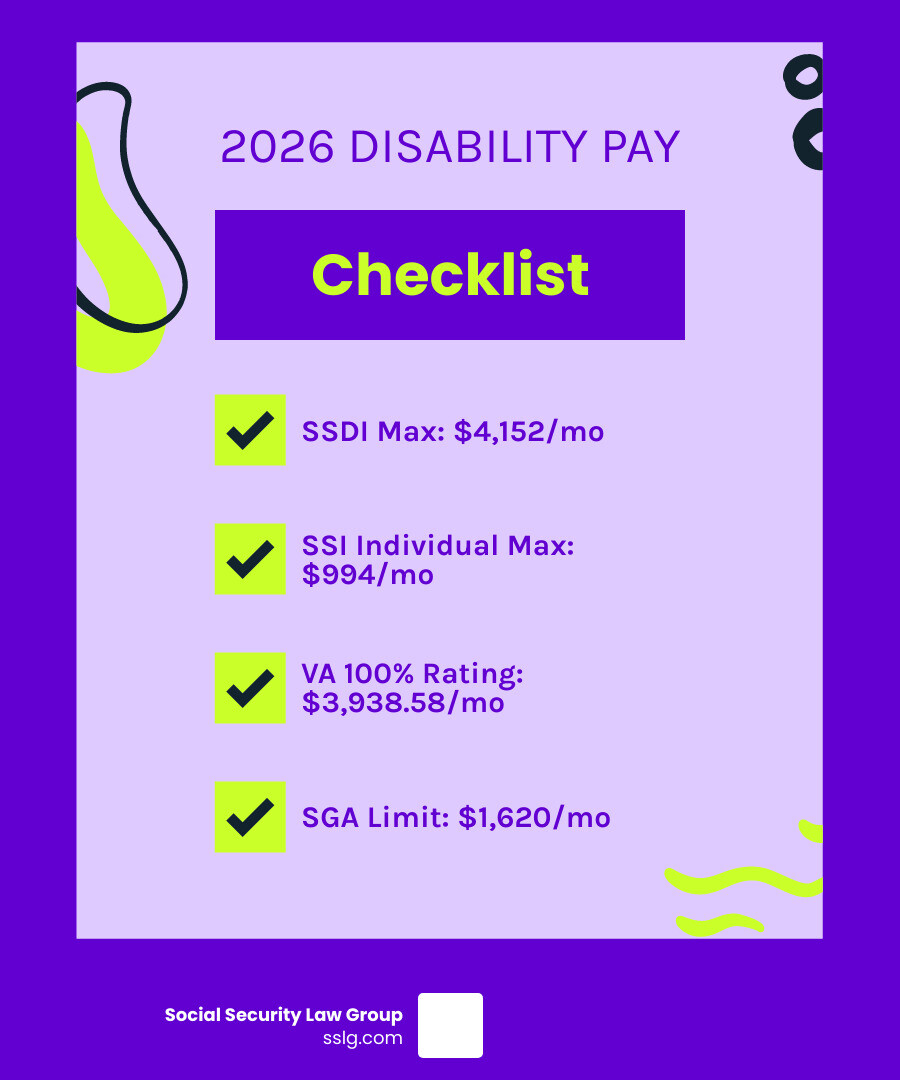
Here is a quick look at the key 2026 figures:
| Benefit Type | 2026 Maximum Monthly Payment |
|---|---|
| SSDI (Social Security Disability Insurance) | $4,152 |
| SSI Individual (Supplemental Security Income) | $994 |
| SSI Couple | $1,491 |
| VA Disability (100% rating, veteran alone) | $3,938.58 |
| Average SSDI monthly payment | ~$1,489 to $1,630 |
Most people do not receive the maximum. Your actual amount depends on your work history, income, assets, disability rating, and dependents.
This guide breaks down how each chart works, how payments are calculated, and what you can expect to receive.
Understanding the 2026 Social Security Disability Pay Chart
When we look at the disability pay chart for 2026, it is important to distinguish between the two primary types of Social Security benefits. Social Security Disability Insurance (SSDI) and Supplemental Security Income (SSI) serve different populations and have very different payment structures.
SSDI is an insurance program. You paid for it through your FICA taxes while you were working in cities like Chicago, Houston, or Seattle. Because it is based on your earnings, the maximum SSDI payment for 2026 has risen to $4,152 per month. This is a significant increase from the 2025 maximum of $4,018. However, the average monthly SSDI payment typically falls between $1,489 and $1,630, depending on your lifetime earnings.
SSI, on the other hand, is a needs-based program. It is designed for individuals with limited income and resources. For 2026, the SSI Federal Payment amounts are set at $994 for an individual and $1,491 for a couple. If you are applying from a location like Denver or Boston, your social-security-disability-benefits-pay-chart for SSI will be the same regardless of your work history, though your actual check may be lower if you have other sources of income.
How COLA Affects Your Disability Pay Chart
The annual cost-of-living adjustment (COLA) is the reason your benefits increase from year to year. The SSA uses the Consumer Price Index, specifically the CPI-W, to measure inflation. When the prices for goods and services rise, the SSA adjusts benefit rates to ensure that your purchasing power stays the same.
For 2026, the 2.8% COLA means that the average beneficiary will see an increase of more than $50 per month. This adjustment is mandatory by law to protect your benefits from being eroded by inflation. You can get the latest cost-of-living adjustment (COLA) information on the Social Security Administration’s (SSA) website to see how these changes have been applied historically. Whether you are living in Atlanta or Phoenix, this increase applies to you automatically starting with your January 2026 payment.
Substantial Gainful Activity (SGA) Limits for 2026
To qualify for disability benefits, you must be unable to engage in what the SSA calls Substantial Gainful Activity (SGA). This is essentially a monthly earnings limit. If you earn more than this limit, the SSA generally considers you not disabled for benefit purposes.
For 2026, the SGA limit for non-blind individuals is $1,620 per month. For individuals who are blind, the SGA limit is higher, reaching $2,700 per month in 2026. If you are working part-time in Dallas or Detroit while waiting for your claim to be processed, it is vital to stay below these thresholds to maintain your eligibility.
Calculating Your SSDI and SSI Monthly Payments

Calculating exactly how much you will receive can feel like a complex math problem. For SSDI, the SSA uses a formula based on your Average Indexed Monthly Earnings (AIME). They look at your top earning years, adjust them for inflation, and then apply a formula to reach your Primary Insurance Amount (PIA).
The PIA formula uses “bend points” that change every year. In 2026, the formula takes:
- 90% of the first $1,286 of your AIME.
- 32% of your AIME between $1,286 and $7,749.
- 15% of any AIME over $7,749.
The sum of these three amounts is your monthly benefit. To get an estimate without doing the manual math, you can use the Online Benefits Calculator provided by the SSA. Understanding how-much-does-ssdi-or-ssi-pay is the first step in planning your financial future while dealing with a disability.
Factors That Reduce Your SSI Disability Pay Chart
While SSDI is based on what you earned, SSI is based on what you have right now. The ssi-amounts-for-2024 and 2026 can be reduced by “countable income.” Countable income includes money you earn from work, but the SSA does not count all of it. They exclude the first $20 of most income and the first $65 of earned income plus half of the remainder.
SSI also has strict asset limits. To remain eligible, an individual cannot have more than $2,000 in countable resources, and a couple cannot have more than $3,000. This includes cash, bank accounts, and stocks. However, your primary home and one vehicle usually do not count toward this limit. If you are in Charlotte or Las Vegas and receive help with food or shelter from a friend or family member, the SSA may also reduce your SSI payment by up to one third.
How Work History Determines SSDI Amounts
Your work history is the foundation of your SSDI claim. To be “insured” for disability, you must have earned enough work credits. Generally, you need 40 credits, 20 of which must have been earned in the last 10 years ending with the year you become disabled.
You can earn up to four credits per year. In 2026, you earn one credit for every $1,810 of earnings. By logging into your myssa.com account, you can see your full earnings history and verify that your credits are accurate. If there is a mistake in your record from a job you held in San Antonio or Miami, it could lower your monthly check, so it is important to review this regularly.
2026 VA Disability Pay Chart and Combined Ratings
For our veterans in cities like Fayetteville and San Diego, the VA disability system operates differently than Social Security. VA disability compensation is a tax-free monthly benefit paid to veterans with disabilities that are the result of a disease or injury incurred or aggravated during active military service.
The Current Veterans Disability Compensation Rates for 2026 have also been adjusted by the 2.8% COLA. A veteran with a 10% rating will receive $180.42 per month. At the other end of the scale, a 100 percent rating for a veteran alone is $3,938.58. Unlike Social Security, VA benefits are not based on your prior income but rather on the severity of your service-connected conditions.
How Dependents and Aid and Attendance Increase VA Pay
If you have a disability rating of 30% or higher, you are eligible for additional compensation for your dependents. This includes your spouse, children under 18, children between 18 and 23 who are in school, and even dependent parents.
For example, a veteran with a 100% rating and a spouse would receive $4,154.12 in 2026. If that veteran also has a child, the amount rises to $4,318.98. There are also special monthly compensation rates for veterans who require “Aid and Attendance.” This is for those who need the regular help of another person to perform daily activities like bathing or dressing.
If your service-connected conditions prevent you from working but your rating is not quite at 100%, you might qualify for Total Disability based on Individual Unemployability (TDIU). This allows the VA to pay you at the 100% rate. To apply for these benefits or an increase, you will likely need to file VA Form 21-526EZ.
The Combined Rating System for Multiple Disabilities
The VA uses a unique method for calculating a total rating when a veteran has multiple disabilities. It is often called “VA Math.” Instead of simply adding percentages together, the VA uses a combined rating system.
The VA starts with your most severe disability. For example, if you have a 50% disability, you are considered 50% disabled and 50% “efficient.” If you have a second disability rated at 30%, the VA takes 30% of that remaining 50% efficiency, which is 15%. Adding that 15% to the original 50% gives you a 65% rating, which the VA then rounds to the nearest 10%, resulting in a 70% combined rating. This ensures that no one can ever be more than 100% disabled.
Payment Schedules and Taxability of Benefits
Knowing when your check will arrive is essential for budgeting. Social Security payments follow a strict social-security-disability-payments schedule based on your birthday.
For SSI recipients, the payment date is almost always the first of the month. If the first falls on a weekend or a federal holiday, you will receive your payment on the business day prior. For example, if you are in St. Louis or Wichita and the first of the month is a Saturday, your SSI should arrive on Friday.
SSDI and SSI Payment Dates for 2026
If you receive SSDI, your payment date depends on the day of the month you were born:
- Born 1st through 10th: Your payment is on the second Wednesday of the month.
- Born 11th through 20th: Your payment is on the third Wednesday of the month.
- Born 21st through 31st: Your payment is on the fourth Wednesday of the month.
If you receive both SSDI and SSI, or if you began receiving benefits before May 1997, your SSDI payment will typically arrive on the third of the month. If you are unsure about your specific date, you can contact your local SSA office for a personalized schedule. Understanding how-much-does-ssi-and-ssdi-pay-together can help you coordinate these two different payment streams.
Frequently Asked Questions about Disability Pay
When do disability payments begin after approval?
For SSDI, there is a mandatory five month waiting period. This means the SSA will not pay you for the first five full months of your disability. Your payments generally begin in the sixth month after your “onset date,” which is the date the SSA decides your disability began.
However, because the application process can take a long time, many people are entitled to back pay. This is a lump sum payment that covers the time from when your benefits should have started until your claim was finally approved. Calculating your AIME and onset date correctly is vital to ensuring you receive every dollar of back pay you deserve.
Are Social Security disability benefits taxable?
Whether your benefits are taxable depends on your total income. According to irs.gov, SSDI benefits are generally not taxed unless your “provisional income” (your adjusted gross income plus non-taxable interest plus half of your Social Security benefits) exceeds $25,000 for an individual or $32,000 for a couple filing jointly.
If you are over these limits, you may have to pay income tax on a portion of your benefits. SSI payments, however, are never taxable. If you live in a state with no income tax like Florida (Miami, Orlando, Ft. Lauderdale) or Washington (Seattle), you won’t have to worry about state taxes on these benefits, though federal rules still apply.
What happens to disability benefits at full retirement age?
When you reach your full retirement age, your SSDI benefits automatically convert to Social Security retirement benefits. The transition is seamless, and your monthly payment amount generally stays exactly the same.
The SSA essentially stops calling it “disability” and starts calling it “retirement.” This is because the PIA for disability is calculated to be the same as your full retirement benefit. You do not need to file a new application for this to happen.
Conclusion
Navigating the disability pay chart and the complex rules of the SSA can be overwhelming. At Social Security Law Group, we have been providing unrivaled expertise in disability law since 1994. Our team is dedicated to helping people in cities from Chicago to San Antonio secure the benefits they have earned.
With a 97% success rate and a no-win, no-fee structure, we take the financial risk out of the legal process. Whether you are just beginning your application or need to appeal a denial, we use modern client technology to make the process as smooth as possible. If you need help understanding your disability-benefits, or want to know how-much-is-disability-in-texas or how-much-does-disability-pay-in-california, we are here to support you. Contact us today to ensure your monthly check reflects the full amount you are entitled to under the law.