


What the 2026 SGA Limits Mean for Your Disability Benefits
2026 substantial gainful activity limits determine whether the Social Security Administration (SSA) considers you able to support yourself through work — and they directly affect whether you can qualify for or keep your disability benefits.
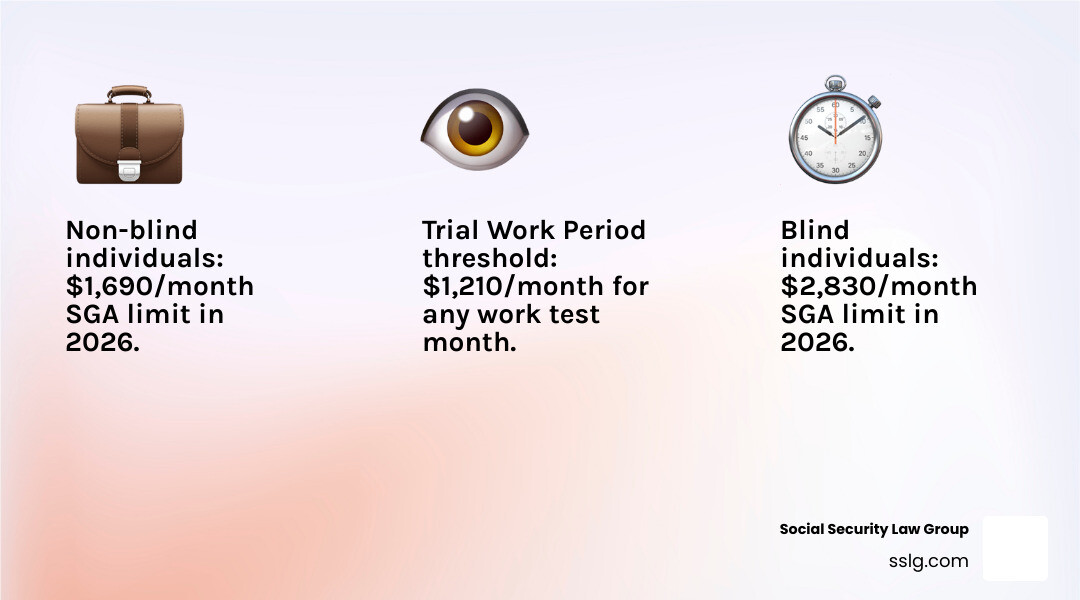
Here are the official 2026 SGA limits, confirmed by the SSA:
| Category | 2026 Monthly SGA Limit |
|---|---|
| Non-blind individuals | $1,690/month |
| Statutorily blind individuals | $2,830/month |
| Trial Work Period (TWP) threshold | $1,210/month |
These figures increased from 2025 due to a 2.8% cost-of-living adjustment (COLA), tied to the national average wage index.
If your countable earnings stay below these thresholds, the SSA generally won’t consider you to be engaging in substantial gainful activity — keeping your benefits intact.
If you earn above these amounts, your eligibility could be at risk. But it’s not always that simple. Deductions, work incentives, and special rules can change what actually counts toward your limit.
That’s exactly what this guide breaks down — year by year, rule by rule.
What is Substantial Gainful Activity (SGA)?
At its core, Substantial Gainful Activity (SGA) is the yardstick the Social Security Administration uses to decide if you are “disabled” under their strict legal definition. Since Social Security disability is intended for those who cannot work due to a severe medical condition, the SSA looks at your monthly income to see if you are performing work that they consider “substantial” and “gainful.”
If you are applying for Social Security Disability Insurance (SSDI) or Supplemental Security Income (SSI) in cities like Chicago, Seattle, or Charlotte, the first thing the SSA does is look at your earnings. If you earn more than the 2026 substantial gainful activity limit, the SSA will likely deny your application immediately, regardless of how severe your medical condition might be.
However, SGA isn’t just a simple “dollars and cents” calculation. It involves looking at the nature of the work you do and the effort it requires. We often help clients in Boston and Denver understand that even if they aren’t making a huge salary, the SSA might still consider their activity “substantial” if it involves significant mental or physical duties.
More info about substantial gainful activity
Defining “Substantial” and “Gainful”
To really understand the 2026 substantial gainful activity rules, we have to break down those two specific words.
- Substantial: This refers to the work activity itself. According to 20 C.F.R. § 404.1572 (a), substantial work involves significant physical or mental activities. Even if you work part-time, or if you have less responsibility than you used to, the SSA can still label your work as “substantial” if it requires significant effort.
- Gainful: This usually means work done for pay or profit. However, it’s broader than that. According to 20 C.F.R. § 404.1572 (b), work is gainful if it is the kind of work usually done for pay, even if you don’t actually receive a paycheck.
This means that certain types of volunteer work or working for a family business without a salary could technically be flagged as SGA if the SSA believes you are performing duties that someone else would normally be paid to do. Interestingly, the SSA even considers illegal activity to be gainful if it involves work for profit. While we hope our clients in Dallas and Atlanta aren’t involved in anything of that nature, it shows just how broad the SSA’s net can be!

Official 2026 substantial gainful activity Limits
Every year, the SSA adjusts the SGA limits based on the National Average Wage Index. For 2026, the cost-of-living adjustment (COLA) has been confirmed at 2.8%. This is great news for beneficiaries in Detroit, Houston, and Phoenix, as it allows for a slightly higher “ceiling” before your benefits are impacted.
For most people—those with physical or mental disabilities other than blindness—the 2026 substantial gainful activity limit is $1,690 per month. This is an increase from the $1,620 limit in 2025. This monthly amount is a gross figure, meaning it is calculated before taxes are taken out.
It is vital to track your monthly income closely. If you are working a part-time job in Las Vegas or Miami, even a small bonus or a few extra hours could push you over that $1,690 mark. We recommend our clients keep every pay stub and use a simple spreadsheet to ensure they stay within the safe zone.
Understanding the 2026 substantial gainful activity Threshold for Blind Individuals
If you are statutorily blind, the rules are significantly more generous. The SSA recognizes that individuals with visual impairments face unique hurdles in the workplace. For 2026, the SGA limit for blind individuals is $2,830 per month, up from $2,700 in 2025.
There is also a major difference between the two main disability programs regarding blindness:
- Title II (SSDI): The $2,830 SGA limit applies.
- Title XVI (SSI): Surprisingly, the SGA test does not apply to blind individuals seeking SSI. While there are still income and resource limits for SSI, the specific SGA monthly earnings threshold isn’t used to deny blind applicants for this program.
Historically, the blind SGA limit has been higher than the non-blind limit since 1978. In fact, back in 1975, both limits were just $200! Seeing the limit rise to $2,830 in 2026 shows how much the wage index has shifted over the decades.
Historical Substantial Gainful Activity (SGA) Thresholds by Year
How 2026 substantial gainful activity Affects Your Trial Work Period
If you are already receiving SSDI benefits and want to test your ability to work, the SSA provides a “safety net” called the Trial Work Period (TWP). This is a fantastic tool for our clients in Raleigh, Fayetteville, and St. Louis.
During the TWP, you can earn as much money as you want for nine months (not necessarily consecutive) within a rolling 60-month window, and you will still receive your full SSDI check. However, not every month counts as a “Trial Work Month.”
For 2026 substantial gainful activity planning, you need to know the TWP threshold: $1,210 per month.
- If you earn less than $1,210 in a month, that month does not count toward your nine months.
- If you earn $1,210 or more, you have used one of your nine trial months.
Once you have used all nine months, the SSA will then look at whether your earnings exceed the standard SGA limit ($1,690) to determine if your benefits should continue.
social-security-disability-ssd-in-north-carolina-your-guide-to-the-trial-work-period-twp
How the SSA Calculates Countable Earnings
When the SSA looks at your paycheck, they don’t just look at the “net” amount that hits your bank account. They start with your gross wages—your pay before any deductions for taxes, insurance, or 401k contributions.
However, they also don’t necessarily count every dollar of that gross pay. The goal of the SSA is to determine the “real value” of the work you are performing. For example, if you are self-employed in San Antonio or Wichita, the SSA looks at your “net earnings from self-employment” (NESE), which is your gross income minus your business expenses. They also look at the amount of time you spend on the business and the value of the services you provide.
Red Book on employment supports
Deductions and Work Incentives
This is where things get interesting (and where a good legal team can really help). There are several ways to lower your “countable” income so that it stays below the 2026 substantial gainful activity limit, even if your gross pay is higher.
- Impairment-Related Work Expenses (IRWE): If you have to pay for things out-of-pocket that allow you to work, you can often deduct those costs. Examples include specialized transportation (if you can’t use public transit), certain medical devices, or attendant care services. If you live in Jacksonville and pay for a specialized van service to get to work, that cost might be deductible from your gross earnings.
- Subsidies and Special Conditions: Sometimes an employer pays you more than the actual value of the work you do. This often happens in “sheltered workshops” or when an employer provides extra supervision, fewer duties, or more frequent breaks because of your disability. If your employer confirms that they are “subsidizing” your pay, the SSA will deduct the value of that subsidy from your gross earnings.
Impairment-related work expenses
Unsuccessful Work Attempts (UWA)
What happens if you try to work, but your disability forces you to stop? The SSA has a rule for “Unsuccessful Work Attempts.”
If you start working at an SGA level but have to stop or reduce your earnings below the SGA limit within six months because of your medical condition, the SSA may disregard those earnings entirely. This prevents you from being penalized for trying to return to the workforce. This is a common scenario for our clients in Sarasota and Orlando who may experience “flare-ups” of chronic conditions that make consistent work impossible.
Comparing SGA Limits: 2024 to 2026
To see how the 2026 substantial gainful activity limits fit into the bigger picture, it helps to look at the progression over the last few years. The steady increase reflects the inflation that everyone in Tampa and Sarasota has been feeling at the grocery store and the gas pump.
| Year | Non-Blind SGA | Blind SGA | TWP Threshold |
|---|---|---|---|
| 2024 | $1,550 | $2,590 | $1,110 |
| 2025 | $1,620 | $2,700 | $1,160 |
| 2026 | $1,690 | $2,830 | $1,210 |
This upward trend is designed to ensure that as wages across the country rise, people on disability aren’t unfairly disqualified just because their pay increased slightly to keep up with the cost of living.
What’s New in 2026? | The Red Book | SSA
Impact on SSI and SSDI Eligibility
While the SGA limit is a major factor for both programs, it’s used differently once you are already receiving benefits.
- For SSDI: If you earn over the SGA limit after your Trial Work Period, your benefits will eventually stop.
- For SSI: The SGA limit is primarily used only when you first apply. Once you are “in the system,” the SSA uses a different formula to reduce your monthly check based on your income. They exclude the first $20 of any income and the first $65 of earned income, then they reduce your SSI check by $1 for every $2 you earn over that.
This means that for SSI recipients in Fort Lauderdale or Miami, you can often work and still receive a partial SSI check, even if you are earning a bit more than you might expect.
Frequently Asked Questions about 2026 SGA
Navigating the 2026 substantial gainful activity rules can feel like walking through a maze. Here are some of the most common questions we hear from our clients in Denver, San Antonio, and Chicago.
Can I work part-time and stay below the SGA limit?
Yes, absolutely. Many people on disability work part-time in North Carolina and other states to supplement their income. The key is to ensure your gross monthly earnings stay under the $1,690 limit (or $2,830 if blind).
However, the SSA doesn’t just look at the money. If you are working 30 hours a week at a very demanding job but only getting paid minimum wage, the SSA might still investigate whether the nature of that work shows you have the ability to engage in SGA.
What happens if my earnings exceed the limit after the TWP?
If you finish your nine-month Trial Work Period and continue to earn over the 2026 substantial gainful activity limit, you enter a 36-month “Extended Period of Eligibility” (EPE).
During these three years:
- In any month you earn above the SGA limit, you won’t get a disability check.
- In any month you earn below the SGA limit, the SSA will send you your full check.
It’s a “safety valve” that allows you to keep your disability status active while you see if your return to work is truly permanent. If your condition worsens again within five years of your benefits stopping, you may be eligible for “Expedited Reinstatement,” which lets you get benefits back without filing a whole new application.
Are self-employed individuals evaluated differently?
Yes. If you run your own small business in Wichita or Southfield, the SSA knows that “income” can be tricky. They use three tests to see if your self-employment counts as SGA:
- Significant Services and Substantial Income: Do you do more than half the work for the business (or 45+ hours a month) and make a decent profit?
- Comparability Test: Is your work similar to what an unimpaired person in your community does for their business?
- Worth of Work Test: Is the work you do worth more than $1,690 a month to the business, even if you aren’t “taking” that much in cash?
Evaluation guides if you are self-employed
Conclusion
Understanding the 2026 substantial gainful activity limits is the first step toward protecting your financial future. Whether you are just starting your application in Seattle or you are considering a return to work in Atlanta, these numbers matter.
At Social Security Law Group, we have been providing unrivaled legal representation for SSD and SSI claims since 1994. With a 97% success rate and a no-win, no-fee structure, we take the stress out of the process. Our modern technology allows us to support clients across all our locations—from Detroit to Miami and everywhere in between.
Don’t leave your benefits to chance. If you have questions about how your work might affect your eligibility, reach out to us today. We are here to ensure you don’t miss a dime of the benefits you’ve earned.
Learn more about substantial gainful activity.